


Pharmacy Inventory and Expiry Management: Common Mistakes UAE Pharmacies Make
I’ve spent the past several years working with pharmacy owners across the GCC, watching how their numbers actually behave once you get past the polished P&L. One thing keeps surprising me: the gap between what owners think their inventory is doing and what it is actually doing.
Most pharmacy owners I talk to in Dubai, Abu Dhabi, Sharjah, and beyond track three numbers closely. Daily revenue. Monthly footfall. Insurance claim rejections. They could tell you those figures off the top of their head. Ask the same owner what their actual expiry write-off was last year as a percentage of revenue, and you usually get a vague estimate that turns out to be optimistic by a factor of two.
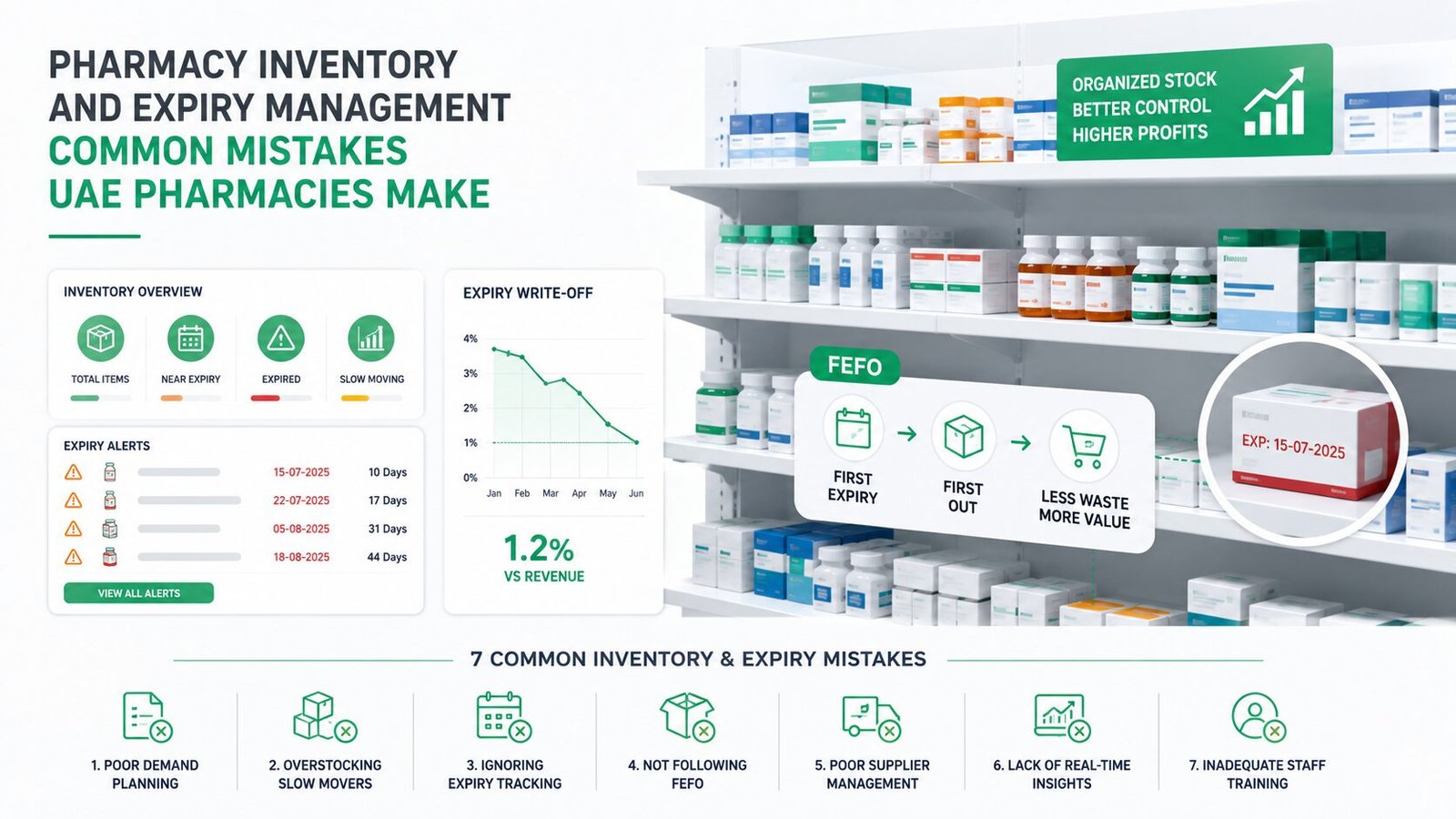
This is the silent profit leak in UAE pharmacy operations. Strong owners run expiry losses below 1.5 percent of revenue. Weak operators sit at 4 to 7 percent. On a pharmacy doing AED 4 million annually, that’s the difference between writing off AED 60,000 and writing off AED 280,000. Same revenue, very different bottom line.
Here are seven inventory and expiry mistakes I see most often in UAE pharmacies, in roughly the order I’d prioritise fixing them.
Mistake 1: Treating Inventory as a Back-Office Problem
This is the one that frustrates me most because it cascades into the other six.
Inventory is not a clerical task. It is the second-largest line on most pharmacy P&Ls, after staffing. A small percentage shift in inventory performance moves more money than any marketing campaign or promotion you’ll ever run. But because inventory work is unglamorous and the wins compound slowly, owners delegate it to whoever is least busy and assume the system will sort it out.
The pharmacies I’ve seen run great inventory operations have one thing in common. The owner or a senior pharmacist looks at inventory metrics every week. Stock turn, expiry exposure, slow-mover lists, and supplier performance are reviewed the same way revenue is reviewed. The discipline is what creates the result.
If you treat inventory as an afterthought, no software in the world will save you. If you treat it as a core operational metric, even mediocre software produces better outcomes than top-tier software run without attention.
Mistake 2: No FEFO Discipline at the Counter
FEFO stands for First Expiry, First Out. The principle is simple: when two batches of the same medicine sit on the shelf, the batch that expires sooner gets dispensed first.
Most pharmacies I visit say they follow FEFO. Almost none actually do, in my experience. I’ve watched pharmacists grab the box at the front of the shelf because that’s the box at the front of the shelf, which is usually the most recently received batch with the longest shelf life. The older batch sits at the back, ages gracefully, and ends up in the expiry write-off pile six months later.
Software should be enforcing this. When the pharmacist scans a medicine to dispense, the system should pick the batch with the earliest expiry, deduct that one from inventory, and only fall back to a newer batch if the older one is exhausted. If your software does not do this automatically, you’re losing money to FEFO failure every single day.
Mistake 3: Letting Slow-Movers Reach Their Expiry Date
Most expired stock didn’t have to expire. Six months before the expiry date, the data shows the medicine isn’t moving. Three months before, the warning signs are unmistakable. By the time it expires, you’ve been ignoring the same signal for half a year.
Expiry alerts at 90, 60, and 30 days are the minimum. But alerts alone don’t solve anything. The owner has to act on them. That means either pushing the slow stock to a sister branch where it sells faster, returning it to the supplier under your return agreement (read your contracts again, you probably have more return rights than you use), or running a targeted promotion to clear it.
I’ve sat across from owners who had stock about to expire in 30 days and still had not decided what to do about it. By the time they decided, the window had closed. Action timing on expiring stock is a discipline that separates the top operators from the rest.
Mistake 4: Tracking Inventory at Product Level Instead of Batch Level
Some older pharmacy software still tracks inventory at the SKU level rather than the batch level. The system tells you “we have 47 units of Atorvastatin 20mg” but cannot tell you “12 of those expire in March, 22 in August, and 13 next year.”
In a UAE pharmacy that has to comply with Tatmeen drug traceability, this is a deal-breaker for compliance reasons before we even get to expiry management. But it also makes inventory decisions blind. You cannot run a real expiry forecast without batch-level data. You cannot transfer the right batches between branches. You cannot return the right boxes to the supplier.
If your current software does not do batch-level tracking integrated with Tatmeen, it has to go. This is one of the ten must-have features any UAE pharmacy software needs, and it is not one of the ones I’d accept compromises on.
Mistake 5: Single-Branch Thinking in Multi-Branch Pharmacies
Chain pharmacies have a powerful tool that single-branch operations don’t: redistribution. A medicine that sells slowly in your Jumeirah branch might sell quickly in your Karama branch. A box approaching expiry in branch A can be moved to branch B and dispensed before it expires.
I see chain pharmacies fail to do this all the time. Each branch manages its own inventory in isolation. Slow stock in one branch sits and ages while the same medicine sells out in another branch and forces a fresh order from the supplier. The inventory inefficiency is enormous.
This is why centralised, cross-branch inventory visibility matters so much for chains. Without it, you’re essentially running multiple independent pharmacies that happen to share a logo. Our guide to multi-branch pharmacy management in the UAE goes into how this works in practice.
Mistake 6: Buying Based on Supplier Deals Instead of Real Demand
Suppliers offer volume discounts, bonus stock, and end-of-quarter incentives. These look attractive on the purchase invoice. They often look very different six months later when the bonus stock is sitting on the shelf approaching expiry.
I’m not saying ignore supplier deals. I’m saying evaluate them honestly. A bulk discount that locks you into 12 months of stock is worthless if your sell-through rate is 8 months. The supplier wins, you lose. The discipline is to buy against your demand pattern, not against the deal.
Strong pharmacy software helps here by showing you sell-through rates, days of stock on hand, and forward-looking demand projections. Without that data, every buying decision is partly guesswork dressed up as commercial savvy.
Mistake 7: Not Auditing Physical Stock Against the System
System inventory and physical inventory drift apart over time. Items get dispensed without being scanned. Returns get processed informally. Damaged stock gets written off the shelf but not off the system. Theft happens (more often than owners want to acknowledge). After 12 months without a physical count, the gap can be 3 to 8 percent of inventory value.
Cycle counts (counting a portion of the inventory each week, rotating through the full stock every quarter or so) keep the numbers honest. Annual full counts are the bare minimum. Pharmacies that run on system numbers without ever physically verifying them are making decisions on data that has quietly become unreliable.
This is unglamorous work. It also catches problems that would otherwise compound for years.
What Good Inventory and Expiry Management Looks Like
The pharmacies I’ve seen run expiry losses below 1.5 percent share these habits.
The owner reviews inventory metrics weekly. Stock turn, expiry exposure, slow-movers, supplier performance, and rejected claims are part of a regular dashboard.
FEFO is enforced by the software, not left to staff memory.
Batch-level tracking is the default, with full Tatmeen integration.
Expiry alerts trigger action, not just emails. There’s a clear protocol: at 90 days do X, at 60 days do Y, at 30 days do Z.
Multi-branch operations move slow stock between branches before it expires.
Buying decisions are made against demand data, not just supplier deals.
Physical counts happen regularly, even if it’s tedious.
None of this is rocket science. It is operational discipline supported by software that does its job. The pharmacies that get the discipline right and the software right run dramatically more profitable operations than the ones that have only one of the two.
Where Software Actually Helps
Good pharmacy software won’t fix inventory discipline that doesn’t exist. But it will make every part of the discipline easier to maintain and harder to skip.
Pharmasolo handles batch-level tracking integrated with Tatmeen, automatic FEFO at the dispensing screen, configurable expiry alerts, cross-branch inventory visibility, supplier performance analytics, and physical count workflows. The full feature breakdown sits in our pharmacy software platform overview, and the UAE version is detailed on the Pharmasolo for Dubai pharmacies page.
If you’re comparing options for your pharmacy, my buyer’s guide to pharmacy management software in Dubai walks through how I’d evaluate vendors against these inventory and expiry capabilities specifically.
Frequently Asked Questions
What’s a normal expiry write-off rate for UAE pharmacies?
Strong operators run below 1.5 percent of revenue. Average pharmacies sit at 3 to 4 percent. Weak operations can write off 5 to 7 percent of revenue annually to expiry losses, often without realising it.
Is FEFO better than FIFO for pharmacy inventory?
Yes. FIFO (First In, First Out) makes sense in retail where products don’t expire. FEFO (First Expiry, First Out) is the right approach for pharmacy inventory because it minimises expiry losses regardless of when stock arrived.
How often should I do a physical inventory count?
At minimum once a year. Better practice is rolling cycle counts that cover the full inventory every quarter. Daily cycle counts of 1 to 2 percent of SKUs catch problems early without disrupting operations.
How do I deal with slow-moving stock approaching expiry?
Three options: transfer to a branch with higher demand, return to the supplier under your return agreement, or run a targeted promotion. Decide and act at least 60 to 90 days before expiry, not 30.
Can pharmacy software prevent expiry losses entirely?
No. Software supports the discipline but doesn’t replace it. The owner still needs to review the alerts and act on them. Software that produces good data and does FEFO automatically takes a large share of the manual work out of the process.
What’s the connection between expiry management and Tatmeen?
Tatmeen requires batch-level tracking of every dispensed medicine. The same batch-level data that satisfies Tatmeen also enables proper expiry forecasting and management. Software that handles Tatmeen well almost always handles expiry well.
Stop Letting Expiry Quietly Eat Your Margin
Expiry losses don’t show up in the P&L the way a rent increase or a bad month of footfall does. They quietly subtract from your bottom line every quarter, and most owners only realise the scale of the problem when they sit down with someone to review the numbers properly.
If you’d like to see what real-time inventory and expiry management looks like in a pharmacy environment built for the UAE market, book a Pharmasolo demo and I’ll have someone from our team walk you through it.


1 Comment
Multi-Branch Pharmacy Management in the UAE: A Guide for Growing Chains - Masirat Technology
June 4, 2026[…] stakes are high. We covered this in detail in our guide to pharmacy inventory and expiry management, but the short version: expiry losses run 3 to 7 percent of revenue for weak operators. Good […]