


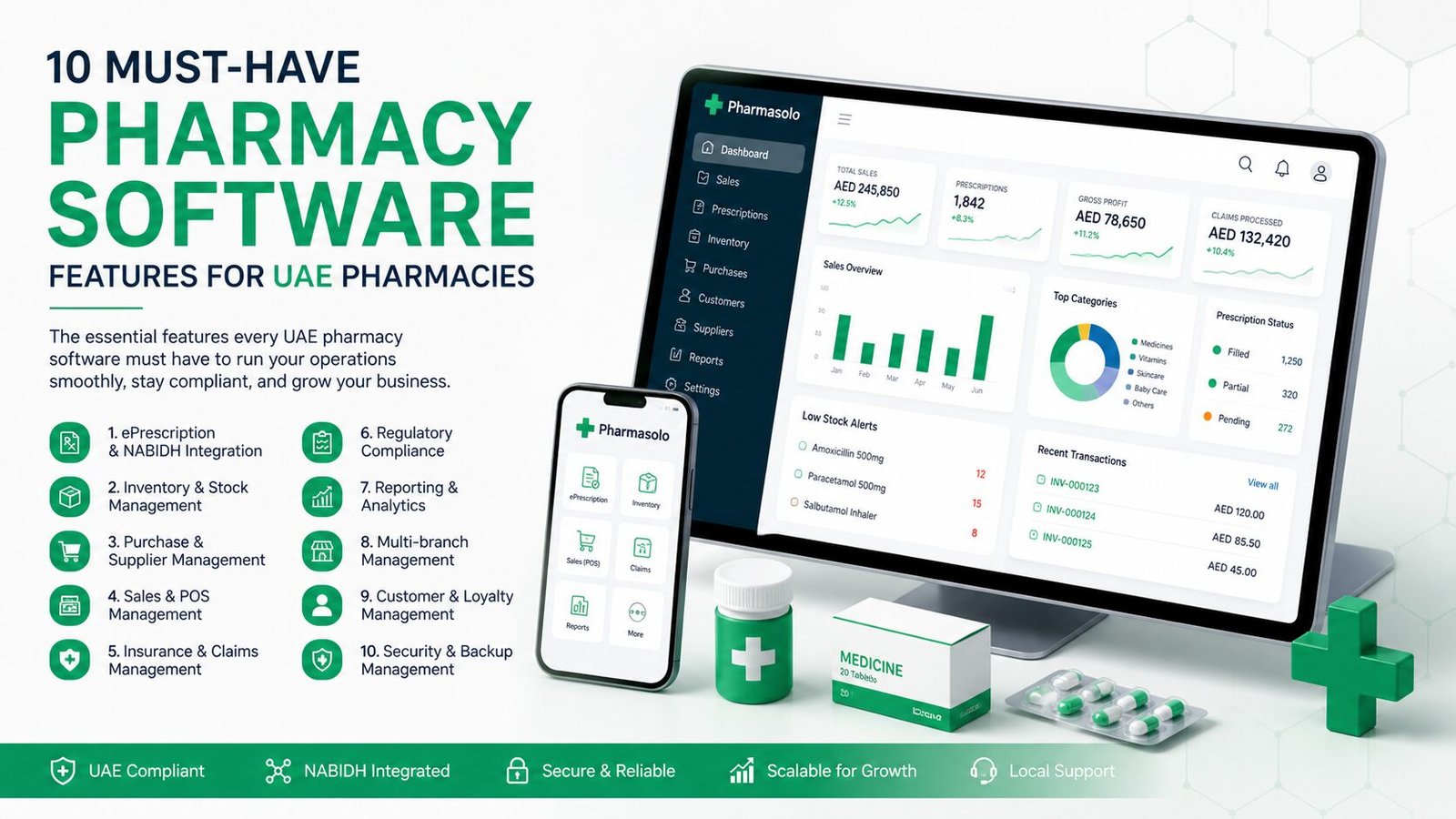
10 Must-Have Features in Pharmacy Software for UAE Pharmacies
Pharmacy software vendors love long feature lists. They put everything from AI drug interaction checks to gamified loyalty programs on the same page and call them all “essential.” For a UAE pharmacy owner trying to make a smart purchase, this noise makes the decision harder, not easier.
Through Pharmasolo’s pharmacy management platform, we’ve worked with pharmacy operators across the GCC long enough to know which features actually matter on the ground in the UAE, and which ones look great in a demo but rarely affect daily operations. This guide cuts to the ten features any UAE pharmacy software must support before it deserves a place on your shortlist.
How to Use This Checklist
Treat this as a screening tool. Any platform that fails on more than one or two of these features is a poor fit for the UAE market, no matter how polished the rest looks. Some features are non-negotiable because they are tied to regulation. Others matter for revenue, margin, or daily workflow. We’ve ordered them so the most critical sit at the top.
For deeper context on why each compliance feature matters and how UAE authorities actually enforce them, our pharmacy software compliance guide walks through the regulatory landscape in detail.
1. NABIDH, Malaffi, and Riayati Integration
This is the first feature to verify, and the one that disqualifies the most software from contention. Pharmacies in Dubai must integrate dispensing data with NABIDH. Abu Dhabi pharmacies connect to Malaffi. Northern Emirates pharmacies operate under MOHAP and connect to Riayati. The three platforms now exchange data through the federal Riayati layer, but your pharmacy software must integrate directly with the platform that covers your operating emirate.
What to look for: native integration with the relevant HIE rather than an external middleware bolt-on, real-time submission of dispensing events, the ability to pull patient health records when needed, and a certification document issued by the relevant authority. If you operate or plan to operate across emirates, the software must support multiple HIEs in a single account.
2. UAE Insurance Network Support
For most UAE pharmacies, insurance claims represent the bulk of revenue. Your software must handle the major networks: Daman, Thiqa, NextCare, MSH International, ADNIC, Mednet, and others depending on your customer base. This means more than just submitting a claim. The software should manage pre-authorisation requests, claim submission in each network’s required format, rejection tracking, resubmission workflows, and aging reports for outstanding claims.
What to look for: live integration with each major insurance network, automatic format conversion for different payers, rejection reason analysis, and reporting that shows you which payers are slowest to settle. Pharmacies losing money on claim rejections are almost always running on software that handles only the basic submission step. Our practical guide to UAE pharmacy insurance claims goes deeper into what good claim management looks like in daily operations.
3. Tatmeen Drug Traceability
Tatmeen is the UAE’s mandatory drug traceability system. Every pharmacy must scan and register every dispensing event through Tatmeen. This is not optional. Pharmacy software that does not handle Tatmeen cannot legally be used to dispense most pharmaceutical products in the UAE.
What to look for: barcode scanning at receiving and dispensing, automatic Tatmeen API submission, batch and expiry tracking integrated with Tatmeen records, and reconciliation tools that flag mismatches before they become inspection failures.
4. E-Prescription Handling
DHA, DOH, and MOHAP have all moved aggressively toward e-prescriptions. Paper prescriptions are still accepted in many cases, but digital prescription volume keeps rising and will eventually become the norm. Your software must receive e-prescriptions from licensed UAE clinicians, validate them against the issuing authority’s standards, and process dispensing in line with the prescribed details.
What to look for: support for DHA, DOH, and MOHAP-issued e-prescriptions, validation against prescriber licence status, a complete prescription audit trail, and integration with the relevant HIE so dispensing data flows back automatically.
5. Multi-Branch and Multi-Emirate Management
Many UAE pharmacies are part of chains, and many independent pharmacies grow into multi-branch operations within a few years. Software that handles a single branch well but cannot scale to multiple locations forces a painful migration later. Worse, software that handles multiple branches in the same emirate but fails when you expand to a different emirate (and therefore a different HIE) creates real operational problems.
What to look for: centralised inventory across branches with branch-level controls, role-based user permissions per branch, consolidated reporting alongside branch-specific reports, and full support for multi-emirate operation under a single account. We cover this side of operations in detail in our guide to multi-branch pharmacy management in the UAE.
6. Inventory, Batch, and Expiry Management
Expiry losses are one of the largest silent profit drains in UAE pharmacies. A pharmacy with weak expiry management can quietly lose 3 to 7 percent of revenue every year to write-offs that better software would have prevented. Inventory management is where margin lives or dies.
What to look for: batch-level tracking integrated with Tatmeen, automatic expiry alerts at configurable thresholds (90, 60, 30 days), suggested transfer rules between branches to redistribute slow-moving stock, FIFO and FEFO dispensing logic, and supplier-level analytics that identify which suppliers consistently deliver short-dated stock.
7. Controlled Drug and Narcotic Tracking
Federal Law No. 8 of 2019 and Executive Regulation No. 6 of 2023 set strict rules for controlled and narcotic drug handling. Manual logbooks for controlled drugs are still legal but increasingly seen as a compliance risk by inspectors. Software must maintain digital controlled drug registers, link every dispensing event to a valid prescription, and produce audit-ready reports for DHA, DOH, or MOHAP on demand.
What to look for: a separate controlled drug register, role-based access controls so only authorised pharmacists can dispense controlled substances, a complete audit trail of every controlled drug movement, and the ability to generate inspection-ready reports without manual rework.
8. VAT and FTA-Compliant Invoicing
5% VAT applies to most pharmacy products in the UAE. Software must produce FTA-compliant tax invoices, correctly classify standard-rated, zero-rated, and exempt items, generate quarterly VAT returns in FTA format, and retain records for at least five years. Pharmacies that have to manually fix VAT records every quarter are running on software that should have been replaced two years ago.
What to look for: automatic VAT calculation at the point of sale, FTA-compliant invoice format, separate handling of zero-rated medicines and supplies, and direct export of quarterly VAT return data.
9. Bilingual Arabic and English Interface
The UAE is bilingual. Your software needs to be too. Customer-facing receipts, prescription labels, SMS notifications, and printed documents should be available in Arabic and English. Internally, staff should be able to choose their interface language. This sounds basic, but plenty of foreign pharmacy software products either skip Arabic entirely or treat it as an afterthought with broken translations.
What to look for: a full Arabic interface (not just translated menus), proper right-to-left layout, Arabic-language receipts and labels, and SMS support in both languages for customer notifications.
10. Cloud Access, Reporting, and Mobile Support
The last item on this list is really three related features. Cloud-based access means owners can check pharmacy performance from anywhere. Modern reporting means real data on stock turn, top-selling products, slow movers, claim aging, staff performance, and margin by category. Mobile support means key functions work on a tablet or phone, especially for owners managing multiple branches.
What to look for: cloud-hosted with proper data residency for the UAE, dashboard reporting that updates in real time, customisable reports for tax filings and management decisions, and mobile-responsive web access or a native app for owners. Cloud or on-premise is a real decision that deserves careful thought, and we cover both sides in our guide to cloud vs on-premise pharmacy software for UAE pharmacies.
What Doesn’t Matter As Much As Vendors Claim
A few features get heavy promotion in sales demos but rarely move the needle in real operations. AI-powered drug interaction checks are useful, but every reasonable platform has them. Customer loyalty programs are nice but not central to most UAE pharmacy economics, where insurance customers dominate. WhatsApp integration is helpful but not transformative. Complex inventory forecasting algorithms sound impressive but rarely beat well-set reorder rules in practice.
When you compare vendors, weight the ten features above heavily and treat the rest as nice-to-have rather than deciding factors.
How Pharmasolo Covers This Checklist
Pharmasolo was built around the ten features in this list because they reflect what UAE pharmacy operators actually need. NABIDH, Malaffi, and Riayati are native integrations. Tatmeen is part of the dispensing workflow. The major UAE insurance networks are supported out of the box. Multi-branch and multi-emirate operation works in a single account. VAT, controlled drug tracking, e-prescriptions, and the bilingual interface are all included.
If you’re evaluating pharmacy software for a UAE pharmacy, explore Pharmasolo for Dubai pharmacies, or read our buyer’s guide comparing pharmacy management software in Dubai for a structured way to weigh your options.
Frequently Asked Questions
Which feature is most critical for a Dubai pharmacy?
NABIDH integration. Without it, your pharmacy cannot legally operate in Dubai. Every other feature on this list matters, but NABIDH compliance is non-negotiable for Dubai operations.
Do all UAE pharmacies need to integrate with all three HIEs?
No. You integrate with the HIE that covers your operating emirate. Dubai pharmacies use NABIDH, Abu Dhabi pharmacies use Malaffi, and Northern Emirates pharmacies use Riayati. If you operate across multiple emirates, you need software that supports all the relevant HIEs in a single account.
Is cloud-based pharmacy software allowed in the UAE?
Yes, provided the cloud provider meets UAE data residency and security requirements. Most modern UAE-licensed pharmacy software runs in the cloud with data hosted in approved local or regional data centres.
How important is bilingual Arabic and English support?
Important. Customer-facing materials and prescription labels should be available in both languages. UAE customers expect Arabic communication options, and inspectors may flag exclusively English receipts during audits.
Can a pharmacy run on software that only has basic insurance claim submission?
Technically yes, but it loses money. Pharmacies with weak claim management see higher rejection rates, slower cash flow, and unrecovered receivables. Strong claim management is one of the highest ROI features in UAE pharmacy software.
What if my software is missing one of these ten features?
It depends which one. Missing NABIDH or Tatmeen support is a deal-breaker. Missing strong multi-branch support might be acceptable for a single-branch independent. Missing bilingual support hurts customer experience but may not block daily operation. Use this list to identify gaps and decide whether they’re tolerable for your specific situation.
Use This Checklist When You Compare Vendors
Print this list, take it to your next vendor demo, and tick each feature off as the salesperson demonstrates it live. Not promises, not roadmap items, not coming soon. A pharmacy software platform that cannot show you all ten features working in production is not ready for your pharmacy.
If you’d like a demo of how Pharmasolo handles each of these in a real UAE pharmacy environment, book a Pharmasolo demo for your UAE pharmacy and our team will walk you through the full feature set live


5 Comments
UAE Insurance Claims for Pharmacies: A Practical Guide to Daman, Thiqa, and NextCare - Masirat Technology
May 5, 2026[…] cover the broader feature evaluation in our guide to the 10 must-have features for UAE pharmacy software, and the regulatory context behind claim formats in our pharmacy software compliance […]
Pharmacy Inventory and Expiry Management: Common Mistakes UAE Pharmacies Make - Masirat Technology
May 6, 2026[…] software does not do batch-level tracking integrated with Tatmeen, it has to go. This is one of the ten must-have features any UAE pharmacy software needs, and it is not one of the ones I’d accept compromises […]
How to Open a Pharmacy in Dubai: A 2026 Step-by-Step Guide - Masirat Technology
May 6, 2026[…] clear-eyed view of what comes after the licence is half the battle. The right pharmacy software setup prevents the third and fourth mistakes on that list, and getting your compliance posture right from […]
Multi-Branch Pharmacy Management in the UAE: A Guide for Growing Chains - Masirat Technology
June 7, 2026[…] cover the broader feature evaluation in our guide to the 10 must-have features for UAE pharmacy software, and the compliance landscape in our pharmacy software compliance […]
Cloud vs On-Premise Pharmacy Software: What UAE Pharmacies Should Choose - Masirat Technology
June 7, 2026[…] you compare vendors, weigh cloud capability alongside the other essentials in our guide to the 10 must-have features for UAE pharmacy software, and use our buyer’s guide to pharmacy management software in Dubai for a structured […]