


Cloud vs On-Premise Pharmacy Software: What UAE Pharmacies Should Choose
This question comes up in almost every conversation I have with pharmacy owners evaluating new software. Cloud or on-premise? And there is a surprising amount of outdated thinking attached to it, usually carried over from how IT decisions were made a decade ago.
I’ll give you my honest position up front, then explain the reasoning and the cases where I’d disagree with myself. For most UAE pharmacies in 2026, cloud is the right choice. Not because cloud is trendy, but because of specific realities about how UAE pharmacy compliance works and how pharmacies actually grow. There are still situations where on-premise makes sense, and I’ll cover those too.
What We’re Actually Comparing
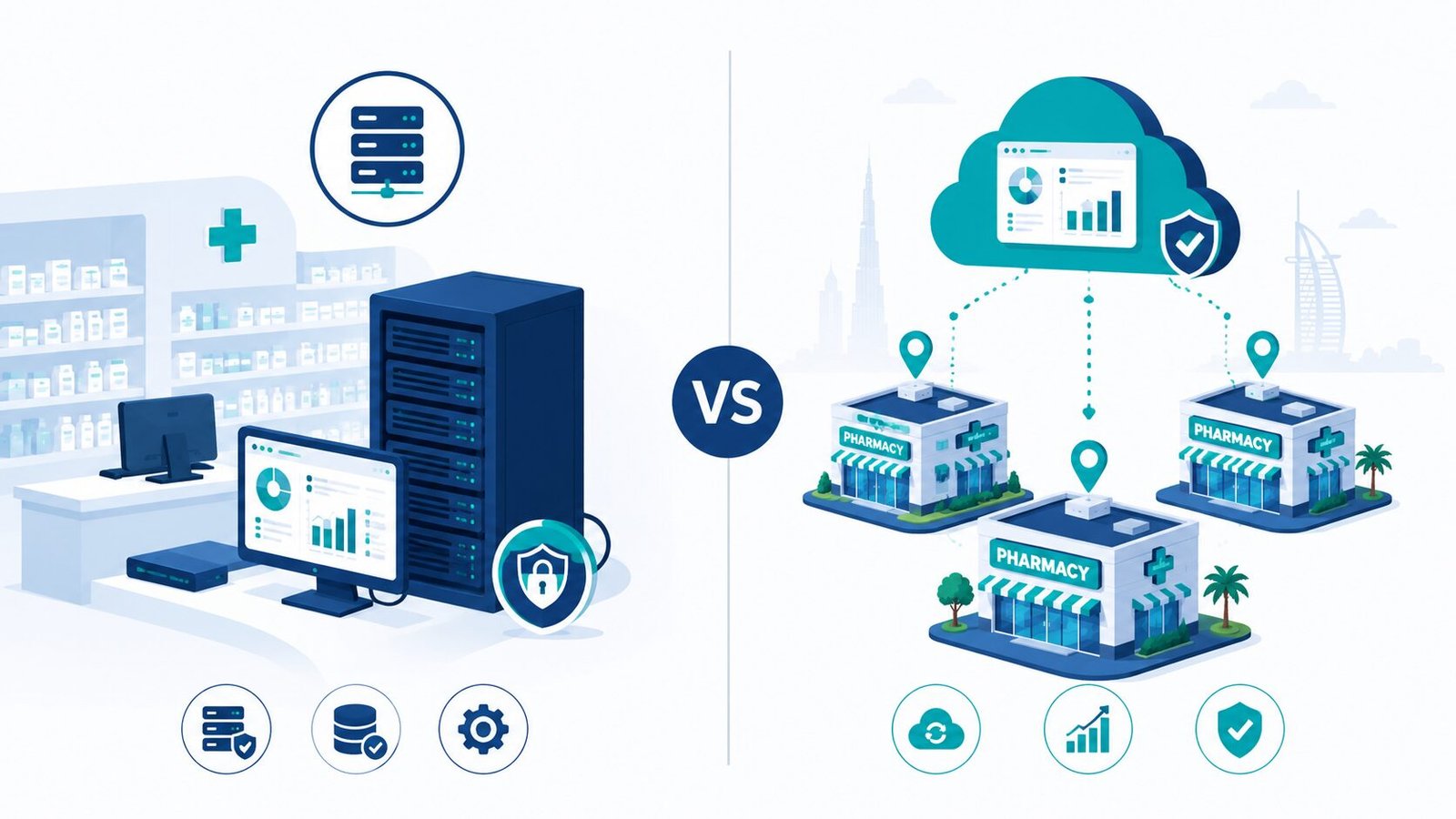
On-premise software runs on hardware physically located in your pharmacy. You buy a server or a powerful computer, install the software on it, and your data lives on that machine in your shop. You own the hardware, maintain it, back it up, and secure it.
Cloud software runs on the vendor’s servers, accessed through the internet. Your data lives in a data centre. You access the software through a browser or app. The vendor handles hardware, maintenance, backups, security infrastructure, and updates. You pay a recurring subscription.
That’s the basic distinction. Everything else follows from it.
The Honest Case for On-Premise
I want to steelman on-premise before I argue against it, because there are real reasons some owners prefer it.
You own your data physically. For owners who are uncomfortable with patient data living on someone else’s servers, on-premise feels safer. The data is in your shop, on your machine, under your control.
You don’t depend on the internet. If your connection drops, an on-premise system keeps running. For a pharmacy in an area with unreliable connectivity, this matters.
The cost structure is one-time rather than recurring. You buy the software and hardware once. No monthly subscription. For owners who hate recurring costs, this is appealing.
These are genuine advantages. If they were the whole picture, the decision would be harder than it is.
Why Cloud Wins for Most UAE Pharmacies
Here’s where the UAE-specific reality tips the balance, and tips it hard.
Compliance updates are the big one. DHA, DOH, and MOHAP change their data standards regularly. NABIDH added AI-based security monitoring in April 2025. Insurance networks update their claim formats. Tatmeen evolves. Every one of these changes requires your software to update.
With cloud software, those updates get pushed automatically by the vendor. You wake up and your software is already compliant with the new standard. With on-premise software, someone has to manually install each update on your machine. If you miss one, or install it late, you fail inspections and get claim rejections. I have seen on-premise pharmacies running months behind on compliance updates because nobody got around to installing them. In a market as regulated as the UAE, that lag is a real liability.
Multi-branch operation is far easier on cloud. If you ever plan to open a second branch, cloud software handles it naturally. All branches access the same system, inventory is visible across locations, and reporting consolidates automatically. On-premise multi-branch requires linking separate servers, which is fragile and expensive. I covered why multi-branch coordination matters so much in our guide to multi-branch pharmacy management, and cloud is the foundation that makes it work.
Disaster recovery is handled for you. If your on-premise server dies (hardware fails, fire, water damage, theft), your data is gone unless you maintained rigorous backups. Most pharmacies don’t. With cloud, your data is backed up and replicated across data centres. A disaster in your shop doesn’t lose your data.
Security is actually better on cloud, not worse. This surprises people. The instinct is that on-premise feels more secure because the data is physically present. But pharmacy owners are not security experts, and most on-premise pharmacy servers are poorly secured: weak passwords, no encryption, outdated operating systems, no monitoring. A reputable cloud provider invests in security infrastructure that no individual pharmacy could match: encryption, access controls, intrusion detection, regular security audits. Your data is usually safer in a professional data centre than on a computer in your back office.
Remote access lets you actually run your business. With cloud, you check your pharmacy’s performance from your phone, from home, from another country. For an owner managing multiple branches or travelling, this is the difference between knowing what’s happening and being in the dark. On-premise ties you to the physical location.
Lower upfront cost frees up capital. Opening a pharmacy is capital-intensive. Cloud software’s lower upfront cost means more of your capital goes into inventory, fit-out, and the things that generate revenue. The recurring subscription is predictable and usually far less than the total cost of buying, maintaining, and eventually replacing on-premise hardware. We break down the full cost picture in our pharmacy software cost guide for the UAE.
The Legitimate Cloud Concern: Data Residency
I won’t pretend cloud has no downsides. The real one in the UAE is data residency.
UAE healthcare data protection rules have specific provisions about where patient data can be stored. Some data must remain in-country or in approved regional data centres. This is the one concern worth taking seriously when you choose cloud pharmacy software.
The answer is not to avoid cloud. It’s to verify that your cloud provider hosts data in compliance with UAE residency requirements. A serious provider serving the UAE market hosts data in the UAE or in approved regional data centres and can show you exactly where your data lives. A provider that can’t answer the data residency question clearly is not ready for the UAE market, cloud or otherwise.
So the data residency concern doesn’t argue for on-premise. It argues for choosing a cloud provider that takes UAE data rules seriously.
The Internet Dependency Question
The other classic objection to cloud is internet dependency. If your connection drops, cloud software stops working.
In the UAE, this is much less of a concern than it would be in many markets. The UAE has some of the best internet infrastructure in the world. Connectivity is reliable in virtually every commercial area. For the rare outage, a backup connection (a second provider or a mobile hotspot failover) costs very little and removes the risk entirely.
Good cloud pharmacy software also handles brief connectivity drops gracefully, queuing transactions locally and syncing when the connection returns. Ask any vendor how their software behaves during a connection drop. The good ones have a clear answer.
When On-Premise Still Makes Sense
I said I’d be fair, so here are the cases where I’d consider on-premise.
If your pharmacy is in a location with genuinely unreliable internet and no practical backup option, on-premise reduces a real operational risk. This is rare in the UAE but not impossible in some remote areas.
If you have a strong philosophical or contractual reason for keeping all data physically in your possession, and you have the IT capability to secure and maintain it properly, on-premise can work. But be honest about whether you actually have that IT capability. Most pharmacies don’t, and a poorly maintained on-premise system is worse than cloud on every dimension.
Outside these cases, I’d choose cloud for almost every UAE pharmacy, and I’d choose it without much hesitation.
My Recommendation
For a new pharmacy in Dubai or anywhere in the UAE, choose cloud pharmacy software hosted in compliance with UAE data residency rules. The automatic compliance updates alone justify the choice in a market this regulated. Add multi-branch readiness, better disaster recovery, stronger security, remote access, and lower upfront cost, and the decision becomes straightforward.
The one thing I’d insist on: verify data residency before you sign. Make the vendor show you where your data is hosted and confirm it meets UAE requirements. This is the single check that separates a cloud provider ready for the UAE market from one that isn’t.
When you compare vendors, weigh cloud capability alongside the other essentials in our guide to the 10 must-have features for UAE pharmacy software, and use our buyer’s guide to pharmacy management software in Dubai for a structured comparison.
Frequently Asked Questions
Is cloud pharmacy software legal in the UAE? Yes, provided the cloud provider hosts data in compliance with UAE data residency and healthcare data protection rules. Most modern UAE pharmacy software runs in the cloud with data hosted in the UAE or approved regional data centres.
What happens to cloud software if my internet goes down? Good cloud pharmacy software queues transactions locally during brief outages and syncs when the connection returns. For longer outages, a backup internet connection (a second provider or mobile failover) removes the risk. The UAE’s strong connectivity makes extended outages rare in commercial areas.
Is my data safer on-premise or in the cloud? Usually the cloud, counterintuitive as that sounds. Reputable cloud providers invest in encryption, access controls, monitoring, and regular security audits that individual pharmacies cannot match. Most on-premise pharmacy servers are poorly secured by comparison.
Does cloud software cost more than on-premise over time? Not usually. On-premise has a lower apparent cost because the subscription is replaced by a one-time purchase, but the total cost of hardware, maintenance, security, backups, and eventual replacement often exceeds cloud subscription costs over a few years. Cloud also frees up upfront capital.
How do compliance updates work with each model? With cloud, the vendor pushes compliance updates automatically, so your software stays current with DHA, DOH, MOHAP, NABIDH, and insurance network changes. With on-premise, someone must manually install each update, which creates a risk of falling behind and failing inspections.
Can I move from on-premise to cloud later? Yes, but data migration takes effort and carries some risk. If you’re choosing software now, choosing cloud from the start avoids a future migration. If you’re already on-premise and frustrated, migration to cloud is worth the one-time effort.
Choose the Model That Lets You Focus on Your Pharmacy
The right software model is the one that takes operational burden off your plate so you can focus on customers, compliance, and growth. For most UAE pharmacies, that’s cloud software hosted in line with UAE data rules.
If you’d like to see how a UAE-ready cloud pharmacy platform handles compliance updates, multi-branch operation, and data residency, book a Pharmasolo demo and I’ll have someone walk you through exactly where your data would live and how the system stays current with UAE regulations. You can also read about the Pharmasolo platform foundation that the UAE version is built on.


