


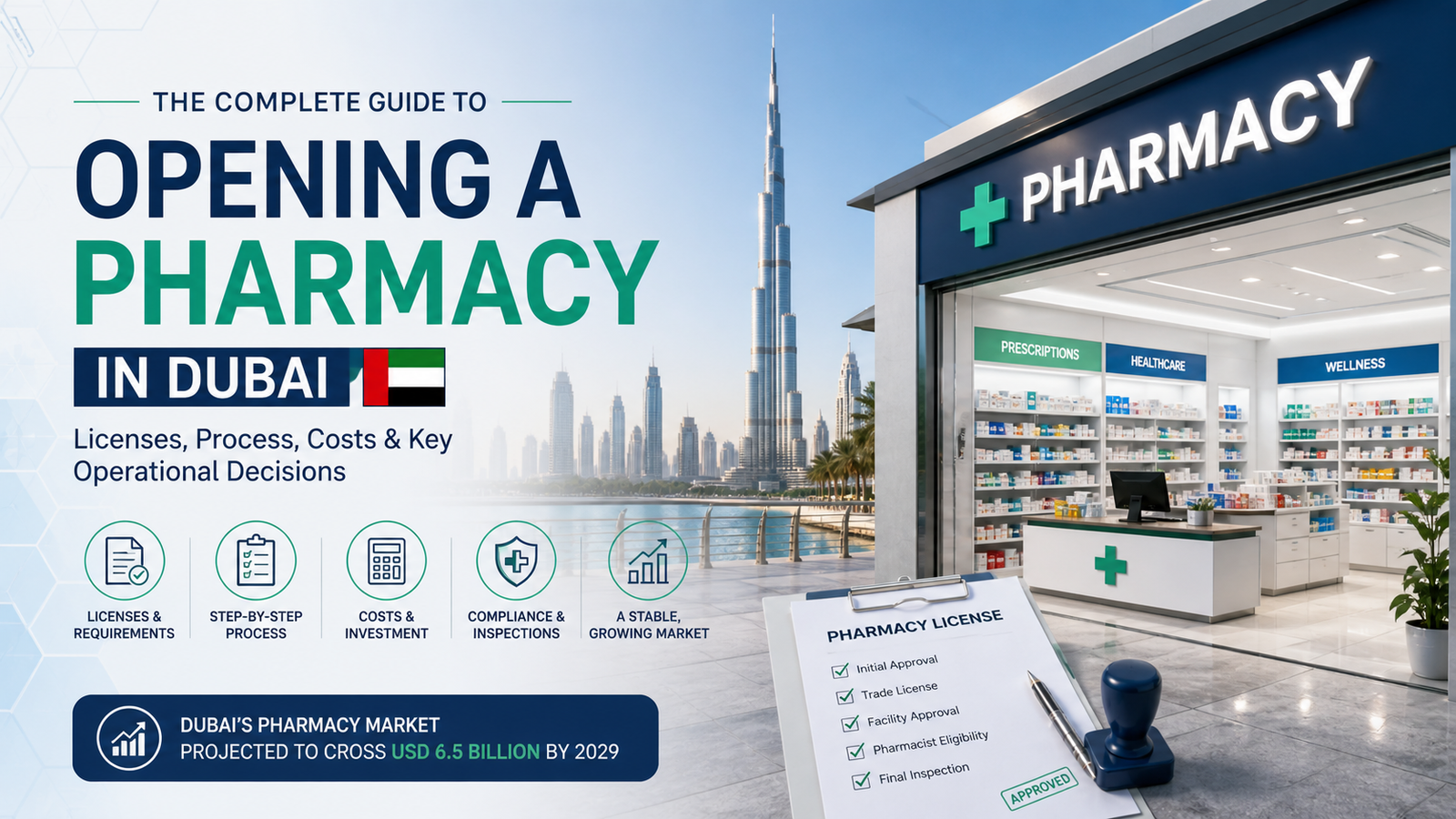
How to Open a Pharmacy in Dubai: A 2026 Step-by-Step Guide
Opening a pharmacy in Dubai is one of the more rewarding healthcare ventures in the region, and one of the most regulated. The process touches multiple authorities, takes a few months on average, and needs real capital. Done right, you end up with a stable, recurring-revenue business in a market projected to cross USD 6.5 billion by 2029. Done without a plan, you waste months on paperwork rejections and failed inspections.
Here’s what you need to know: who can open a pharmacy, which licences are involved, how the process actually unfolds, what it really costs, and the operational decisions worth making before you sign your first lease.
Why Dubai Is a Strong Market for New Pharmacies
The numbers explain the interest. Dubai had around 1,495 active pharmacies as of 2023 and keeps adding more each year, supported by a growing population, expanding insurance coverage, and a steady flow of medical tourists. The UAE pharmacy market is expected to hit roughly USD 5.52 billion by the end of 2025 and keep climbing.
What makes Dubai stand out from other GCC markets comes down to three things. Start with regulatory clarity. The Dubai Health Authority publishes its rules openly, so you know exactly what you are signing up for. Then there’s the digital infrastructure. Systems like NABIDH (Dubai’s health data exchange) and Tatmeen (the UAE’s drug traceability platform) mean modern pharmacies operate inside a connected ecosystem rather than as isolated retail shops. And the recent shift to 100% foreign ownership for mainland pharmacies has removed a major barrier for international entrepreneurs.
If you already operate in the region and are scaling up, the systems you’ve built for places like Oman or Saudi Arabia translate well. We see this with customers using Pharmasolo’s pharmacy management software, which already supports GCC-wide compliance and is now ready for the UAE market.
Who Can Open a Pharmacy in Dubai
You have two paths. Either open the pharmacy yourself if you are a licensed pharmacist with the right experience, or be the investor and hire a licensed pharmacist as the responsible technical lead.
If you plan to be the responsible pharmacist yourself, you’ll need a recognised pharmacy degree (BPharm, MPharm, or PharmD), at least two years of post-graduation retail or hospital pharmacy experience, a valid licence to practise in your home country, a Good Standing Certificate, and a passing score on the DHA Prometric exam (60% minimum).
If you’re an investor without a pharmacy background, you can still own the business outright. You will need at least one DHA-licensed pharmacist on the licence as the responsible pharmacist. Many pharmacy owners in Dubai operate this way and never dispense a single prescription themselves.
Ownership rules have shifted recently, and this matters. Foreign investors can now own 100% of a mainland pharmacy in Dubai under the latest UAE commercial law reforms. A few years ago, a 51% UAE national partner was mandatory. Some older guides online still quote the old rule, so always verify the current position with DET or a licensed business setup consultant before structuring your company.
Types of Pharmacy Licences in Dubai
Before you apply for anything, decide which type of pharmacy you’re opening. Dubai’s licensing structure recognises several models:
- Community or retail pharmacy. The most common type. Standalone shops in residential neighbourhoods, malls, or commercial complexes.
- Hospital pharmacy. Located inside a hospital, requires a separate licence tied to the hospital’s healthcare facility licence.
- Ambulatory pharmacy. Serves outpatient units within larger healthcare facilities.
- Inpatient pharmacy. Operates within day surgery clinics and similar in-facility settings.
- Online or e-pharmacy. A growing category in the UAE with its own additional approval process.
Most new entrants start with a community pharmacy. The rest require existing healthcare facility partnerships or specialised approvals, which is a longer path.
Step-by-Step Process to Open a Pharmacy in Dubai
The process has nine practical steps. Some run in parallel rather than strictly in sequence.
Step 1: Build Your Business Plan and Pick a Location Strategy
Decide your target customer first: residential walk-ins, hospital-adjacent prescriptions, online delivery, or a mix. Forecast monthly revenue and expenses, then shortlist three or four neighbourhoods. Location dictates rent, foot traffic, and competition density. Areas like Jumeirah, Business Bay, and Downtown attract premium rents but high-volume traffic. Suburban areas are cheaper but slower to break even.
Plenty of new owners skip this step and pick a location based on rent alone. They regret it within six months.
Step 2: Choose Mainland or Free Zone
Most retail pharmacies operate on the mainland under DET (Department of Economy and Tourism). Free zones offer some tax and ownership advantages but limit where you can serve customers and have stricter operational scope for retail. For a typical community pharmacy, mainland is the default.
Step 3: Reserve Your Trade Name and Get DET Initial Approval
Submit your proposed trade name to DET. The name must follow UAE naming conventions (no offensive terms, no religious references, no abbreviations of founder initials in some cases). Once the name is approved, you receive an initial trade approval, which is your green light to apply for DHA approvals.
Step 4: Apply for DHA Initial Approval
This is where the healthcare-specific licensing begins. Submit your business plan, owner profile, proposed pharmacist information, and intended location to DHA through the Sheryan portal. DHA reviews your application and issues an initial approval, which is valid for a fixed window (usually six months).
Step 5: Lease and Set Up Your Premises
Your premises must meet DHA’s physical standards. Minimum size is 30 square metres. You’ll need proper ventilation, climate control, refrigeration for temperature-sensitive medications, a separate consultation area, and a layout that allows safe storage and dispensing. Get DHA’s layout guidelines before signing any lease, because retrofitting a non-compliant space costs more than choosing the right one upfront.
Step 6: Licence Your Pharmacists
If you don’t already have a DHA-licensed pharmacist on board, this is when you hire one. Each pharmacist must complete the Sheryan registration, pass DataFlow’s Primary Source Verification, clear the DHA Prometric exam, and obtain a facility-linked licence. Budget around AED 1,500 to 3,000 per pharmacist for licensing, plus DataFlow fees of approximately AED 935 base.
Step 7: Complete Fit-Out and Pass DHA Inspection
Build out your pharmacy according to the approved layout. Install shelving, refrigeration, point-of-sale terminals, security systems, and signage. Once ready, request a DHA facility inspection. The inspector checks compliance against your initial approval. Any non-conformities must be fixed before you can move forward.
Step 8: Set Up Your Pharmacy Software and System Integrations
This is the step most new owners underestimate. Before you can dispense a single prescription, your pharmacy needs software that integrates with NABIDH for patient health records, supports Tatmeen for drug traceability, handles insurance billing for networks like Daman, Thiqa, and NextCare, manages controlled substance reporting, tracks expiry dates, and produces VAT-compliant invoices for the FTA. That’s a long list, and pharmacy software built for non-UAE markets often misses half of it.
Pharmasolo’s UAE-ready pharmacy software covers all of it. DHA, MOHAP, and NABIDH compliance is built in. The major UAE insurance networks are supported out of the box. Multi-branch controls and inventory management are there from day one. The full feature breakdown sits in the Pharmasolo UAE launch announcement.
Step 9: Final Licence Issuance and Opening
Submit your inspection clearance, pharmacist licences, and remaining documents. DHA issues the final pharmacy operating licence. Pay the licence fee. Your pharmacy is now legal to operate. Plan a soft opening to test workflows before you advertise widely.
How Much Does It Cost to Open a Pharmacy in Dubai
Costs vary widely based on size, location, and how much fit-out work is needed. Realistic ranges for a new community pharmacy in Dubai look like this:
- Trade licence: AED 10,000 to 15,000
- DHA approvals (initial and final): AED 20,000 to 30,000
- Pharmacist DHA licensing: AED 1,500 to 3,000 per pharmacist
- Annual lease: AED 100,000 to 500,000 (location-dependent)
- Fit-out and equipment: AED 50,000 to 100,000
- Initial inventory: AED 100,000 to 300,000
- Pharmacy software, IT, and integrations: AED 15,000 to 40,000 in year one
- Visas, permits, and other admin: AED 10,000 to 20,000
Total initial investment for most new community pharmacies in Dubai falls between AED 500,000 and AED 1.3 million. A premium location with a flagship build-out can push that significantly higher. A small independent pharmacy in a suburban area can sit at the lower end.
How Long Does the Process Take
For a well-prepared application, the full timeline runs about two to three months. Pharmacist licensing in parallel can take longer if DataFlow verification with foreign universities is slow (three to six weeks is normal). Plan for delays. Lease negotiations, fit-out delivery, and inspection rescheduling all add real days.
Common Mistakes That Slow Down New Pharmacy Owners
A few patterns repeat across owners who hit roadblocks.
Signing a lease before getting DHA layout guidelines, then discovering the space cannot meet inspection requirements. Underestimating fit-out cost on the assumption that a basic retail build-out will pass DHA standards. Picking pharmacy software based on price alone, then realising it does not support NABIDH or insurance billing for the networks they need. Hiring a pharmacist without checking their DataFlow status first. Skipping a real business plan because the licensing process feels like the whole job, when in reality the operations after launch are.
A clear-eyed view of what comes after the licence is half the battle. The right pharmacy software setup prevents the third and fourth mistakes on that list, and getting your compliance posture right from day one prevents the rest.
Why Your Pharmacy Software Choice Matters From Day One
Most new pharmacy owners pick software last and treat it as a back-office decision. That’s a mistake. In the UAE, your software is the system that connects you to NABIDH, processes the insurance claims that often make up the majority of your revenue, files your VAT returns, manages expiry losses (a major silent profit drain), and gives you the data you need to grow.
Pick the wrong system and you spend the first year fighting workflow gaps. Pick the right one and you focus on customers and growth. If you’re comparing options, our buyer’s guide to pharmacy management software in Dubai walks through what to look for and how to evaluate vendors fairly.
Frequently Asked Questions
Can a foreigner own 100% of a pharmacy in Dubai?
Yes. Under recent UAE commercial law reforms, foreign investors can own 100% of a mainland pharmacy in Dubai. Confirm the latest position with DET or a licensed business setup consultant for your specific structure.
Do I need to be a pharmacist to open a pharmacy?
No. You can be the investor and hire a DHA-licensed pharmacist as the responsible pharmacist on the licence.
How long does the DHA licensing process take?
About two to three months end to end for a well-prepared application, assuming pharmacist DataFlow verification doesn’t delay the timeline.
What is the minimum size for a pharmacy in Dubai?
DHA requires a minimum of 30 square metres, plus separate consultation space, refrigeration, and proper ventilation.
Is NABIDH integration mandatory?
Yes. Dubai pharmacies must integrate with NABIDH to share and access patient health records. Your pharmacy software must support this from day one.
How much does a pharmacy licence cost in Dubai?
The DHA-related fees alone fall between AED 20,000 and 30,000. Total setup, including trade licence, lease, fit-out, inventory, and software, typically ranges from AED 500,000 to AED 1.3 million.
Can I run an online pharmacy in Dubai?
Yes, but online pharmacy licences require additional DHA approvals beyond a standard retail licence. Plan for a longer setup if this is your model.
Ready to Set Up Your Dubai Pharmacy the Right Way
Opening a pharmacy in Dubai rewards owners who plan carefully. Get the licensing right, pick a location that fits your model, hire qualified pharmacists, and choose pharmacy software that handles UAE-specific compliance from day one.
If you’re at the planning stage and want a software platform built for the UAE market, explore Pharmasolo for Dubai pharmacies or get in touch with our team. We help pharmacy owners across the GCC run cleaner operations, file insurance claims faster, and stay compliant with the rules that matter.


