


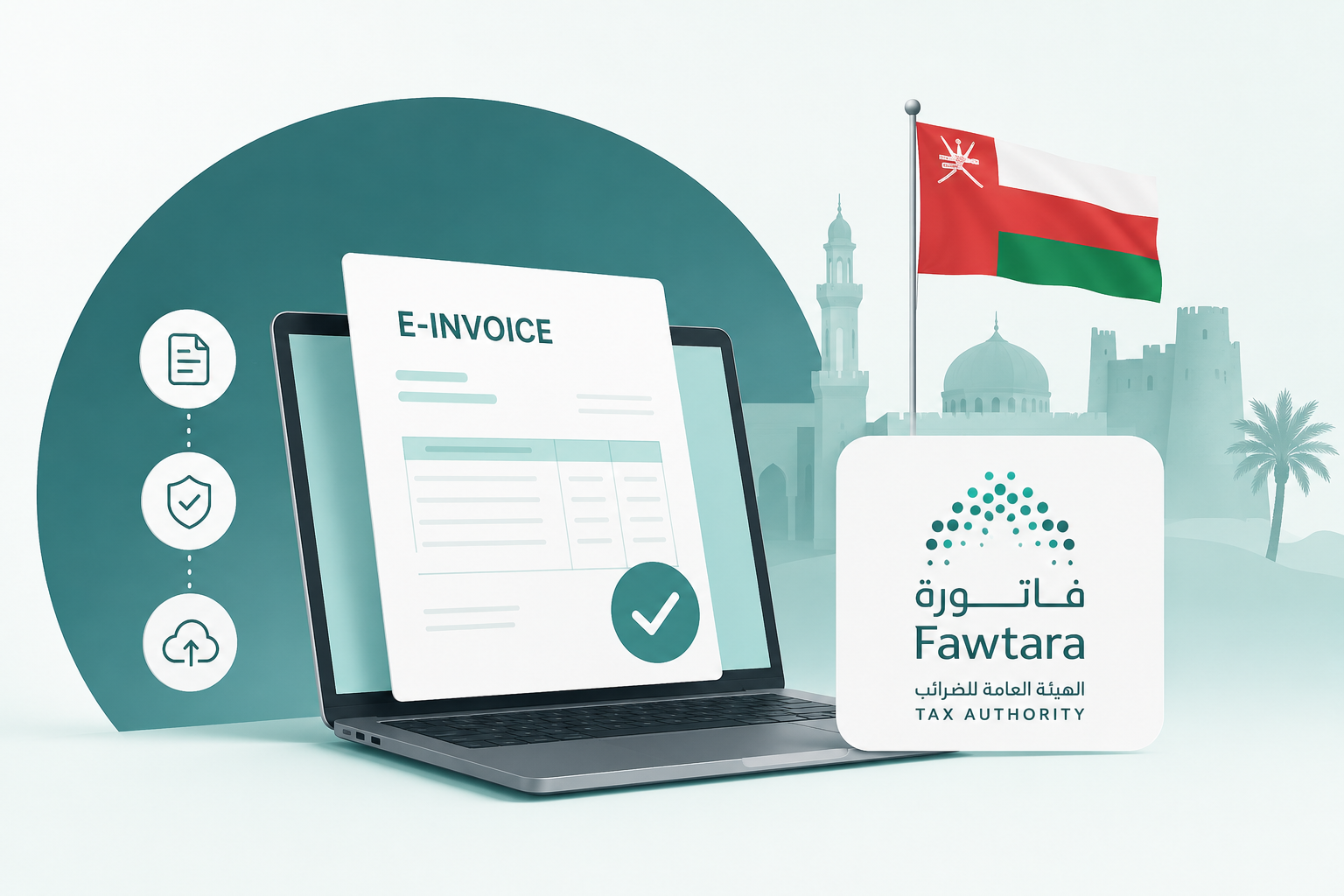
E-Invoicing in Oman: What Fawtara Means for Your Business
If your business is registered for VAT in Oman, the way you issue invoices is about to change. Fawtara is the Oman Tax Authority’s e-invoicing mandate, requiring VAT-registered businesses to issue structured electronic invoices, and it starts rolling out from August 2026.
Most of what has been written about this so far is aimed at large corporations with finance departments and tax advisers. This guide is for everyone else. Small and medium businesses in Oman will be pulled into the system too, and the deadline is closer than it looks.
Here is what Fawtara is, when it affects you, and what to do about it.
What is Fawtara?
Fawtara is Oman’s national e-invoicing system, run by the Oman Tax Authority and built in partnership with Omantel. It replaces paper and PDF invoices with invoices issued electronically in a standard digital format, sent automatically between the seller, the buyer, and the Tax Authority for real-time validation. Each e-invoice is electronically certified and carries a unique verification code.
The word Fawtara comes from the Arabic for invoice.
The important thing to understand is that this is not just “emailing a PDF.” A PDF invoice is a picture of data. An e-invoice under Fawtara is structured data that machines read and validate automatically, in a specific format, passed through approved channels. Sending a PDF will no longer count.
Who has to comply, and when
The rollout happens in four phases. Phase 1 covers the first 100 large VAT-registered companies from August 2026. Phase 2 extends to all large VAT-registered companies from February 2027. Phase 3 captures all remaining VAT-registered taxpayers, including SMEs, from August 2027. Phase 4 covers government institutions on a date not yet announced.
| Phase | Who | From |
|---|---|---|
| Phase 1 | First 100 large VAT-registered companies | August 2026 |
| Phase 2 | All large VAT-registered companies | February 2027 |
| Phase 3 | All remaining VAT-registered businesses, including SMEs | August 2027 |
| Phase 4 | Government institutions and entities | To be announced |
If you run a small or medium business in Oman, Phase 3 is your date. August 2027 sounds far away. It is not, once you account for choosing a provider, changing your invoicing system, testing it, and training your staff.
Businesses not yet in a phase can join voluntarily early, with support from the Tax Authority. There is a reasonable argument for doing exactly that, since being early means fixing problems at your own pace rather than against a deadline.
Who does not have to comply
If a seller is not VAT registered, they are not required to be part of the Fawtara network. Those sellers cannot charge VAT, so there is no VAT for the buyer to claim.
There is also a sensible transition rule. A VAT-registered business that has not yet reached its rollout phase can keep issuing invoices the way it does now, as long as those invoices meet the existing VAT rules. Buyers receiving them can still claim VAT as normal.
So nothing breaks on day one for businesses waiting for a later phase. You just need to be ready when your phase arrives.
What actually changes for your business
Four things change in practice.
Your invoicing system has to produce the right format. Invoices need to be issued in XML or PDF/A-3 format with API connectivity, directly from an approved electronic system. Typing an invoice in Word or building one in a basic spreadsheet stops being an option.
You will work through a service provider. Invoices move through a five-party model: the supplier, the supplier’s service provider, the buyer’s service provider, the buyer, and the Oman Tax Authority. You send your invoice to an accredited service provider, who validates and passes it on.
The electronic invoice becomes the legal document. Once implementation is official, the e-invoice is the only legal invoice. Your paper copy stops being the record that counts.
Corrections work differently. You cannot quietly edit an issued invoice. Changes are made by issuing an electronic credit or debit note. This is a real workflow change for businesses used to reprinting a corrected invoice.
What about penalties?
Penalties will apply under the regulations, but with a grace period before enforcement begins.
That grace period is useful, and it is also the reason many businesses will leave this too late. The gap between “technically required” and “actively penalised” tends to make people relax. The businesses that struggle will be the ones discovering in mid-2027 that their accounting software cannot produce a compliant invoice at all.
How to prepare
Five steps, in a sensible order. Start with the first one now, even if your phase is a year away.
1. Check what your current system can actually do. Can your accounting or billing software produce structured XML output in the format Oman requires? The technical specification is called PINT OM, based on UBL 2.1 XML. If you are running an older system, or invoicing out of spreadsheets, the honest answer is probably no. Better to find that out now than in your compliance month.
2. Follow the Tax Authority for updates. The OTA publishes technical specifications, accredited provider lists, and training sessions on its website. The rules are still being finalised in places, so this is worth checking periodically rather than once.
3. Choose an accredited service provider. You will need a provider accredited by the OTA that integrates with your accounting system and handles digital signing, validation, and secure storage. Do not leave this to the last quarter, when everyone else is doing the same thing.
4. Fix your data before you migrate it. Missing VAT numbers, inconsistent customer records, and incomplete product details all cause validation failures. Structured invoicing is unforgiving about incomplete data in a way that PDF invoicing never was. Cleaning this up early saves a lot of rejected invoices later.
5. Train your finance and counter staff. New workflows for issuing, correcting, and archiving invoices need people who understand them. A system nobody knows how to use properly creates more compliance risk, not less.
What this means for smaller businesses in Oman
Most of the discussion around Fawtara has focused on large taxpayers, because they are first. But the biggest practical impact lands on Phase 3, where every remaining VAT-registered business has to comply at once.
If you are running a shop, a pharmacy, a small distributor, or a services company, the question is simple. Does the software you bill from today produce structured e-invoices, and can it connect to an accredited provider? If yes, your work is mostly administrative. If no, you need a plan for changing systems, and that is not a two-week job.
This is worth raising with whoever supplies your accounting or billing software now, so you know where you stand. Our own accounting software, Manage Desk, is built for businesses in Oman, and e-invoicing readiness is part of what we are working through with the businesses that use it.
FAQ
What is Fawtara?
Fawtara is the Oman Tax Authority’s national e-invoicing system. It requires VAT-registered businesses to issue structured electronic invoices that are validated in real time rather than sent as paper or PDF.
When does e-invoicing become mandatory in Oman?
It rolls out in phases. August 2026 for the first 100 large companies, February 2027 for all large VAT-registered companies, and August 2027 for all remaining VAT-registered businesses including SMEs. Government entities follow in a fourth phase.
Does e-invoicing apply to small businesses in Oman?
Yes, if you are VAT registered. Small and medium businesses fall into Phase 3, from August 2027. Businesses that are not VAT registered are not required to join the network.
Can I still send PDF invoices?
Not once your phase begins. Invoices must be issued in the required structured format from an approved system. Until your phase starts, you can continue with your current method as long as it meets existing VAT rules.
How do I correct a mistake on an e-invoice?
By issuing an electronic credit or debit note. You cannot edit or reissue the original invoice the way you might with a paper one.
Will there be penalties?
Yes, penalties apply under the regulations, though the Tax Authority has indicated a grace period before enforcement begins.
Do I need new software?
Possibly. If your current system cannot produce structured XML invoices or connect to an accredited service provider, you will need to upgrade or change. Checking this early is the single most useful thing you can do right now.
Start checking now, not in 2027
Fawtara is not a proposal any more. Phase 1 begins in August 2026, and every VAT-registered business in Oman follows within about a year of that.
The businesses that handle this well will be the ones that checked their systems early, cleaned up their data, and picked a provider before the rush. The ones that struggle will be the ones who assumed a 2027 deadline meant a 2027 problem.
If you want to talk through what your current setup can handle, or you are weighing up accounting software that is built for businesses operating in Oman, get in touch with the Masirat team.
This guide is for general information and is not tax advice. Fawtara requirements are still being finalised in places. Check the Oman Tax Authority’s official e-invoicing FAQ or speak to a qualified tax adviser for your specific situation.


