


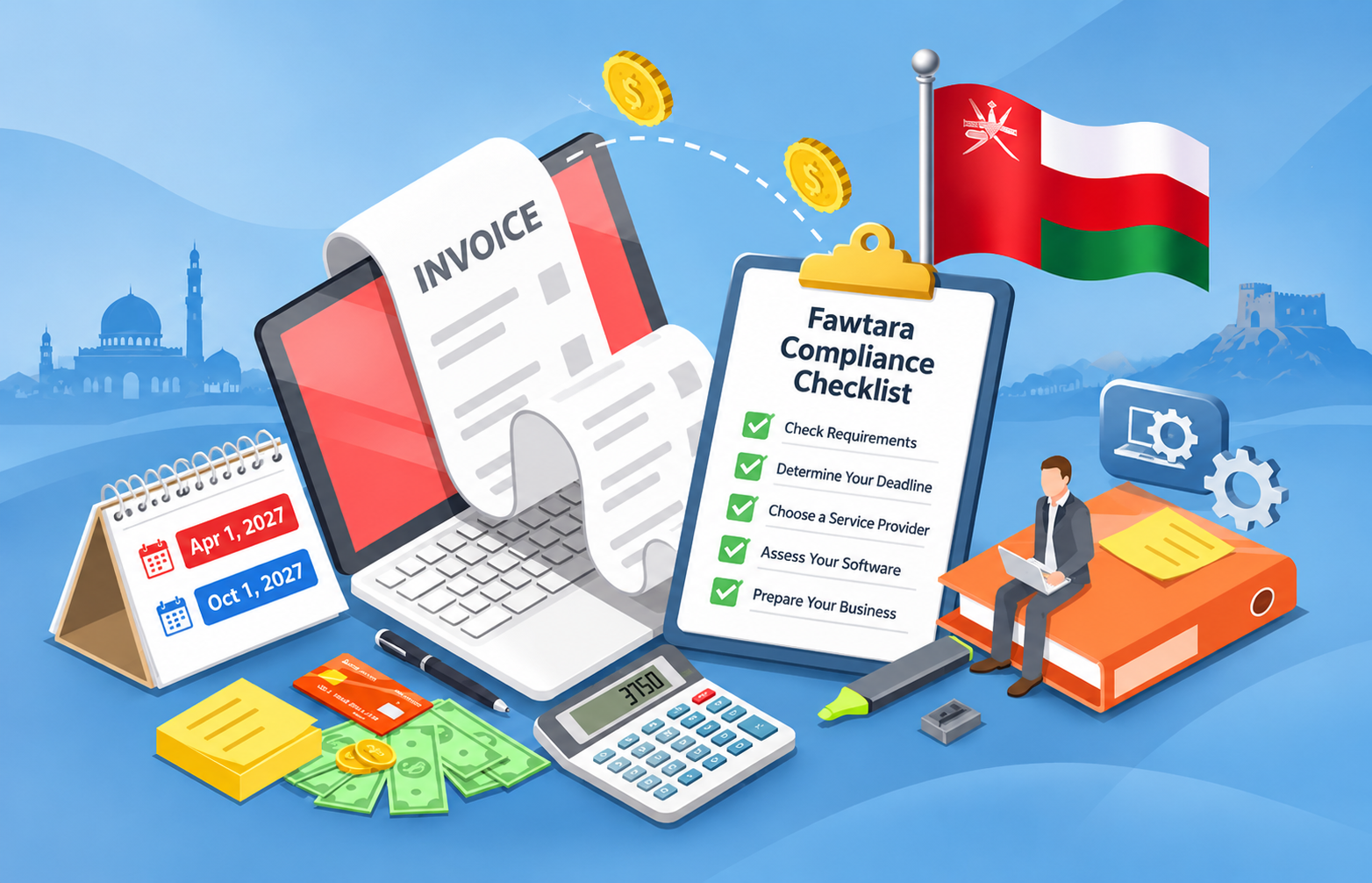
Oman E-Invoicing Requirements: A Business Readiness and Compliance Checklist
If you issue VAT invoices in Oman, you need to know two things: what the Oman e-invoicing requirements actually are, and which Oman e-invoicing deadline applies to you. The first deadline is 1 April 2027, and the Oman Tax Authority e-invoicing programme, Fawtara, is already under way.
This is the practical follow-up to our beginner’s guide to Fawtara, so we skip the basics. It covers the rules, how to find your date, how to choose a service provider, what to check in your software, and a checklist to work through. Everything is current as of 18 November 2026. Start early, because cleaning data, choosing a provider and testing all take time.
What Are the E-Invoicing Requirements in Oman?
For businesses, understanding the Oman e-invoicing requirements means knowing what needs to change in their invoicing processes, software and record management before their implementation date.
Under the Fawtara framework, businesses subject to the mandate must use a compliant electronic invoicing solution and an accredited service provider to issue and exchange invoices through the approved network.
The main requirements include:
Structured electronic invoice format
Invoices must be issued in the prescribed structured format. The Oman Tax Authority’s technical documentation identifies XML as the mandatory structured format. A PDF document alone does not meet this requirement.
Accredited service provider
Taxpayers must select an accredited service provider or apply for accreditation themselves if they meet the OTA’s eligibility criteria.
Invoice validation and transmission
Electronic invoices must be validated through the issuer’s accredited service provider and exchanged according to the applicable submission timelines.
Accurate invoice information
Businesses should ensure that their invoice data, customer details, VAT information and transaction records are accurate and complete.
Electronic record management
Businesses must maintain their electronic invoice records and ensure they can retrieve the required information when needed.
The OTA’s official Fawtara technical documentation provides further information about the structured invoice format, implementation process and technical requirements.
It is important to remember that adopting electronic invoicing does not replace your existing VAT responsibilities. Businesses must continue to follow the applicable VAT invoicing and record-keeping rules.
Oman E-Invoicing Implementation Dates and Deadlines
One of the first things businesses should determine is when they need to implement Fawtara.
Under Ministerial Decision No. 189/2026, which amends certain provisions of Oman’s VAT Executive Regulations, the mandatory implementation schedule is divided into two categories based on annual supplies.
| Business category | Mandatory implementation date |
|---|---|
| Taxpayers whose annual supplies exceed OMR 5 million | 1 April 2027 |
| Taxpayers whose annual supplies do not exceed OMR 5 million | 1 October 2027 |
The distinction is based on the value of annual supplies, not the company’s annual profit or net income.
You can read more about the legal amendments in KPMG’s explanation of Oman’s VAT Executive Regulations and e-invoicing implementation.
How Is the OMR 5 Million Threshold Calculated?
The Oman Tax Authority has provided specific guidance explaining how businesses should calculate their annual supplies to determine their implementation date.
The calculation includes:
- The value of taxable supplies, excluding supplies of capital assets.
- The value of goods and services subject to the Reverse Charge Mechanism.
- The value of intra-GCC supplies of goods and services.
Businesses must consider two assessment periods.
First assessment period: 1 April 2026 to 31 March 2027
If the total value of supplies during this period exceeds OMR 5 million, the business falls under the 1 April 2027 implementation date.
Second assessment period: 1 April 2027 to 31 March 2028
Businesses must also consider their expected total supplies during this period. If the expected value exceeds OMR 5 million, the earlier implementation date applies.
If neither condition is met, the applicable implementation date is 1 October 2027.
Example:
Imagine a business has supplies worth OMR 4.2 million during the first assessment period. However, based on its business projections, it expects its supplies to reach OMR 5.5 million during the following year.
Since its expected supplies exceed the OMR 5 million threshold, the business falls under the 1 April 2027 implementation date.
What If Your Business Is Part of a VAT Group?
Businesses operating under a VAT group should pay particular attention to the threshold calculation.
According to OTA guidance, the OMR 5 million threshold is assessed at the VAT group level rather than separately for each company within the group.
For example, if three companies belong to one VAT group, their supplies must be considered collectively when determining the applicable threshold.
For non-resident taxpayers, the calculation is based on supplies made within Oman.
If you are unsure which category your business falls into, review your VAT records and consult the Oman Tax Authority or a qualified tax professional.
Useful resource: The OTA has an official Fawtara implementation checker. Businesses can enter their VAT identification number and select their current and expected annual supplies to check their potential implementation period. The tool is intended for awareness and readiness purposes, so businesses should still verify their obligations against the applicable regulations.
Who Needs to Comply with Fawtara in Oman?
Fawtara is not intended only for large corporations.
The OTA’s published guidance confirms that SMEs are also included in the implementation. Businesses will be brought into the system according to their applicable implementation dates.
The main categories include:
Large businesses: Taxpayers whose annual supplies exceed OMR 5 million will be required to implement e-invoicing from 1 April 2027.
Small and medium-sized businesses: Taxpayers whose annual supplies do not exceed OMR 5 million will generally fall under the 1 October 2027 implementation date.
VAT groups: Businesses registered as a VAT group should assess their combined supplies rather than looking at each group member separately.
Non-resident taxpayers: The threshold calculation for non-resident taxpayers is based on supplies made within Oman.
Businesses should not assume that their size or industry automatically exempts them from the requirements.
For individual circumstances, refer to the Oman Tax Authority’s Fawtara FAQs and seek professional advice where necessary.
How to Choose an Accredited Service Provider (ASP)
Selecting an appropriate Accredited Service Provider is an important part of preparing for Fawtara.
An Accredited Service Provider, or ASP, is a service provider authorised by the Oman Tax Authority to facilitate electronic invoicing services within the approved framework.
Businesses must identify and select an accredited provider or apply for accreditation themselves if they meet the relevant OTA eligibility requirements.
However, choosing a provider should involve more than comparing prices. Businesses should consider how the provider’s solution will work with their existing accounting systems and daily invoicing operations.
Here are some important factors to evaluate.
1. Verify accreditation
Confirm that the service provider has been accredited by the Oman Tax Authority. Do not rely solely on claims made in advertisements or on company websites.
2. Check software integration
Ask whether the provider can integrate with your existing accounting software, ERP or billing system.
3. Understand invoice validation and transmission
Find out how the provider handles invoice validation, submission and exchange through the Fawtara network.
4. Evaluate technical support
Ask about onboarding assistance, troubleshooting, maintenance and support availability.
5. Consider business requirements
A company issuing hundreds of invoices every month may have different requirements from a small business issuing a limited number of invoices. Consider transaction volumes, branches, users and future growth.
6. Understand pricing
Ask for a clear breakdown of implementation costs, subscription fees, transaction charges and any additional integration expenses.
Before making a decision, compare the available options and make sure the provider can support your business requirements.
You can refer to the OTA’s official Fawtara technical resources for information about taxpayer onboarding and service provider accreditation.
Does Your Existing Accounting or Billing Software Need to Change?
Many businesses in Oman already use accounting software, billing applications or ERP systems to manage their daily transactions.
Naturally, one of their biggest concerns is whether they need to purchase an entirely new system to meet the e-invoicing requirements.
The answer is: not necessarily.
The OTA’s guidance allows businesses to continue using their existing ERP systems, subject to the required arrangements with their accredited service providers and technical compatibility.
However, your existing software must be capable of supporting the electronic invoicing process through an appropriate integration or compatible solution.
For example, consider a business that currently uses accounting software to:
- Generate customer invoices.
- Calculate VAT.
- Manage customer and supplier records.
- Track payments.
- Maintain transaction histories.
- Generate financial reports.
Before adopting Fawtara, the business should evaluate whether its existing system can provide the required invoice data in the prescribed format and exchange it through its accredited service provider.
Simply generating a PDF invoice and emailing it to a customer is not sufficient under the new framework.
What Should You Ask Your Software Provider?
Before purchasing a new system or changing your existing software, ask your provider:
- Does the software support the required XML invoice format?
- Can it integrate with an OTA-accredited service provider?
- Can it support the applicable B2B, B2C and B2G invoicing processes?
- How are invoice errors and rejected submissions handled?
- Can invoice records be stored and retrieved when required?
- Will the software receive updates when OTA technical requirements change?
- Is technical support available during implementation?
These questions can help you understand whether your current system needs an upgrade, an integration or a different solution.
The objective is to ensure that your accounting and invoicing processes can support the required electronic exchange without unnecessarily replacing systems that are already working well.
How Can Businesses Prepare for Fawtara? A Step-by-Step Guide
Preparing for e-invoicing involves more than selecting a service provider. Businesses should review their internal processes, financial information, software and employees before their implementation dates.
Here are eight practical steps to follow.
Step 1: Determine Your Implementation Date
Start by identifying whether your business falls under the April or October 2027 implementation date.
Review your annual supplies, including the relevant taxable supplies, reverse-charge transactions and intra-GCC supplies.
If your business belongs to a VAT group, remember that the threshold is assessed at the group level.
Step 2: Review Your Existing Invoicing Process
Take a closer look at how your business currently creates and manages invoices.
Consider:
- Are invoices generated manually or through software?
- How are invoices shared with customers?
- How are VAT amounts calculated?
- Where are invoice records stored?
- How are corrections and credit notes managed?
- Are different invoicing procedures followed across branches?
Identifying existing gaps will help you understand what needs to change.
Step 3: Evaluate Your Accounting or Billing Software
Check whether your existing software can support the required invoice format and integration.
Speak with your software provider about compatibility with the Fawtara framework.
Avoid assuming that software is compatible simply because it can generate digital invoices or PDF documents.
Step 4: Review Customer and Supplier Information
Accurate information is essential for electronic invoice processing.
Review your customer and supplier databases and check that important information is complete and up to date.
This may include:
- Customer names and business details.
- VAT registration numbers, where applicable.
- Supplier information.
- Billing addresses.
- Transaction details.
- Product and service descriptions.
Incomplete or inaccurate information can create difficulties when preparing and validating invoices.
Step 5: Select an Accredited Service Provider
Identify a suitable service provider and understand how its solution will connect with your current accounting system.
Discuss integration, invoice validation, technical support, onboarding procedures and pricing before making a decision.
Step 6: Prepare Your Finance and Accounting Team
Your finance team should understand how the new invoicing process will work.
Employees responsible for billing, VAT reporting, accounts receivable and financial administration should receive appropriate training.
Step 7: Test Your Systems Before the Deadline
Do not wait until the mandatory implementation date to discover that your invoicing system has integration problems.
Work with your software provider and accredited service provider to test invoice generation, data exchange and validation.
Testing early provides time to identify and resolve technical issues.
Step 8: Follow Official OTA Updates
E-invoicing implementation is a developing process, and businesses should monitor official announcements, technical documentation and updated guidance.
Refer to the Oman Tax Authority’s official Fawtara portal for the latest information.
Common Mistakes Businesses Should Avoid When Preparing for E-Invoicing
Although the implementation dates may seem far away, delaying preparation can create unnecessary challenges.
Here are some common mistakes businesses should avoid.
1. Waiting until the deadline approaches
Selecting software, reviewing business data and arranging integration can take time. Starting early gives businesses more flexibility to resolve problems.
2. Assuming PDF invoices are sufficient
A PDF invoice sent through email is not automatically a compliant electronic invoice under Fawtara. Businesses must use the prescribed structured format and approved exchange process.
3. Ignoring software integration
A billing system may work perfectly for everyday invoicing but still lack the functionality needed for electronic invoice exchange.
4. Overlooking customer and supplier information
Incomplete records can affect invoice preparation and validation. Reviewing master data early can help prevent avoidable errors.
5. Choosing a provider without checking accreditation
Businesses should verify that their selected service provider has the appropriate OTA accreditation.
6. Assuming smaller businesses are exempt
SMEs are also included in the implementation. Businesses should determine their applicable deadline instead of assuming that the requirements only affect large companies.
7. Ignoring employee training
Even a technically suitable system can create operational difficulties if employees do not understand how to use it.
What Should Businesses Look for in E-Invoicing Software?
Choosing suitable e-invoicing software is an important part of preparing for Fawtara.
Businesses should look beyond basic invoice creation and consider whether their existing or future software can support the required invoicing process.
Here are some important capabilities to evaluate:
Automated invoice generation: The system should help businesses generate invoices accurately and reduce repetitive manual work.
Integration capabilities: It should be able to connect with the relevant accredited service provider and support the required data exchange.
Accurate VAT calculations: Businesses should be able to manage their applicable VAT information and invoice details accurately.
Structured invoice support: The solution should support the prescribed electronic invoice format rather than relying only on PDF generation.
Secure record management: Businesses should be able to maintain and retrieve invoice records when needed.
Reporting capabilities: Useful reports can help finance teams monitor transactions and manage their accounting activities.
Scalability: The software should be able to support business growth, additional users and multiple branches where required.
Technical support: Reliable assistance is important when configuring integrations, resolving errors and maintaining the invoicing process.
Most importantly, businesses should verify that the proposed software and service-provider arrangement meet the applicable Fawtara requirements. A software product should not be considered OTA-compliant merely because it advertises electronic invoicing functionality.
Official Resources and Further Reading
For businesses looking for more detailed information, the following resources provide useful guidance:
- Oman Tax Authority – Fawtara FAQs – Official answers to questions about implementation dates, eligibility and taxpayer responsibilities.
- Oman Tax Authority – E-Invoicing Technical Documentation – Technical information about XML invoice formats, implementation procedures and invoice submission.
- Oman Tax Authority – Fawtara Implementation Checker – A tool to help taxpayers identify their potential implementation period.
- Oman Tax Authority – Official E-Invoicing Portal – Official announcements and information about the Fawtara programme.
- KPMG – Oman Tax Authority Amends VAT Executive Regulations – Professional commentary on Decision No. 189/2026 and the legal implementation schedule.
- Deloitte – Oman E-Invoicing (Fawtara): Are You Ready for Implementation? – Additional guidance on implementation planning, software readiness and service-provider selection.
Disclaimer: This article is intended for general informational purposes and does not constitute legal, tax or accounting advice. E-invoicing requirements and technical guidance may be updated by the Oman Tax Authority. Businesses should refer to the latest official guidance and obtain professional advice where necessary.


