

In-House vs Outsourced Software Development: What Works in Oman
Every growing business in Oman eventually faces this decision: should we build our software team in-house, or should we outsource software development? It is one of those choices that can shape your company for years to come, so it is worth thinking through carefully.
Both options have clear advantages, and neither one is automatically better than the other. The right answer depends on your budget, your timeline, the type of project you are building, and how much control you want over the development process.
In this article, we will compare in-house and outsourced software development from a practical perspective. We will look at costs, flexibility, quality, and communication so you can decide what works best for your business. If you are still exploring your options, our guide on choosing the right software development company in Oman is a great starting point.
What Does In-House Development Look Like?

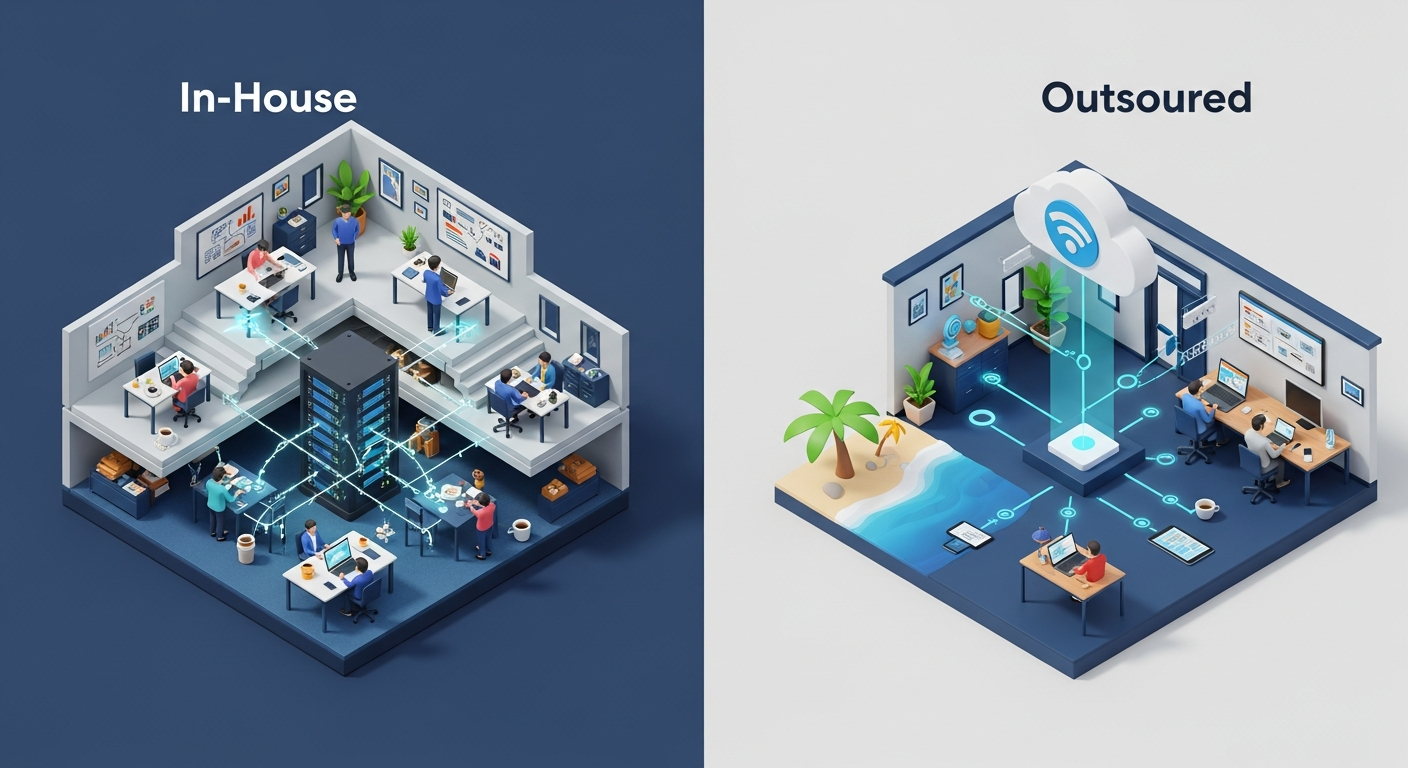
In-house development means hiring full-time developers who work directly for your company. They sit in your office (or work remotely as part of your team), attend your meetings, and focus exclusively on your projects.
The Benefits of Going In-House
Having a dedicated team gives you full control over the development process. Your developers understand your business deeply because they live and breathe it every day. Communication is immediate, and you can shift priorities quickly when business needs change.
In-house teams also build up institutional knowledge over time. They understand your codebase, your users, and your internal processes in ways that an outside team might not.
The Challenges of In-House Teams
The biggest challenge is cost. Hiring, training, and retaining skilled developers in Oman takes a significant investment. You need to account for salaries, benefits, office space, tools, and ongoing professional development.
- Recruitment takes time: Finding qualified developers can take weeks or months, especially for specialized roles.
- Retention is competitive: Good developers are in high demand across the GCC, and keeping them requires competitive compensation.
- Scalability is limited: If a project suddenly requires more developers, you cannot scale up overnight.
- Skill gaps: Your team may not have expertise in every technology your project requires.
What Does Outsourced Development Look Like?
Outsourcing means partnering with an external software development company to build your product. The company provides the team, the tools, and the project management, while you focus on your core business.
The Benefits of Outsourcing
Outsourcing gives you access to a wider range of skills and experience. A good development partner has worked across multiple industries and technologies, which means they bring tested solutions to your project instead of figuring things out from scratch.
It is also more flexible from a financial perspective. You pay for the project or the hours worked, without the long-term commitment of full-time salaries. This makes outsourcing especially attractive for one-time projects, MVPs, and businesses that are not ready to hire a full tech team.
If you want to understand how a strong outsourcing partner approaches scalability, take a look at how Masirat Technology builds scalable software solutions.
The Challenges of Outsourcing
The main concern most businesses have is communication. When your development team is outside your organization, staying aligned takes extra effort. Regular check-ins, clear documentation, and defined milestones help bridge this gap.
Another concern is quality control. Not all outsourcing partners are created equal, and choosing the wrong one can lead to delays, poor code quality, or products that do not match your expectations. That is why asking the right questions before hiring is so important.
A Side-by-Side Comparison
Here is a quick look at how the two options stack up across the factors that matter most:
- Cost: In-house is higher upfront (salaries, benefits, tools). Outsourcing is project-based and more predictable.
- Speed to start: In-house takes months to recruit. Outsourcing can start within weeks.
- Control: In-house gives you direct oversight. Outsourcing requires trust and clear processes.
- Scalability: In-house is harder to scale. Outsourcing lets you add or reduce resources as needed.
- Long-term value: In-house builds internal expertise. Outsourcing delivers immediate results with less overhead.
The Hybrid Approach: Getting the Best of Both
Many businesses in Oman are finding success with a hybrid model. They keep a small in-house team to manage core systems and day-to-day tech needs, while outsourcing larger projects or specialized work to an external partner.
This approach gives you the stability and institutional knowledge of an internal team, combined with the flexibility and specialized skills of an outsourcing partner. It also helps manage costs more effectively, since you only scale up externally when a project demands it.
For businesses looking at financial management solutions, for example, you might have your in-house team handle integrations while outsourcing the core build of something like a custom financial management solution.
Which Option Is Right for You?
There is no one-size-fits-all answer. If your business depends heavily on technology and you have the budget for it, building an in-house team makes sense in the long run. If you need to move fast, keep costs flexible, or access specialized skills, outsourcing is the smarter path.
The most important thing is choosing a path that aligns with your current stage of growth, your financial resources, and your project goals. Whatever you decide, make sure you have a clear plan for communication, quality assurance, and long-term maintenance. And if you want to understand the full cost picture before deciding, our FAQ on custom software development costs in Oman lays it all out.
Let Masirat Help You Build What Is Next
Masirat helps businesses in Oman grow with the right mix of technology and strategy. We are a trusted SEO Expert in Oman, focused on building strong and sustainable online campaigns. As a leading software development company in Oman, we design and develop custom websites, mobile apps, and scalable digital solutions. Through Pharmasolo, our pharmacy management software in Oman, we also support healthcare businesses with smarter, more efficient operations. Partner with Masirat for reliable App & Web development in Oman backed by real experience.


