


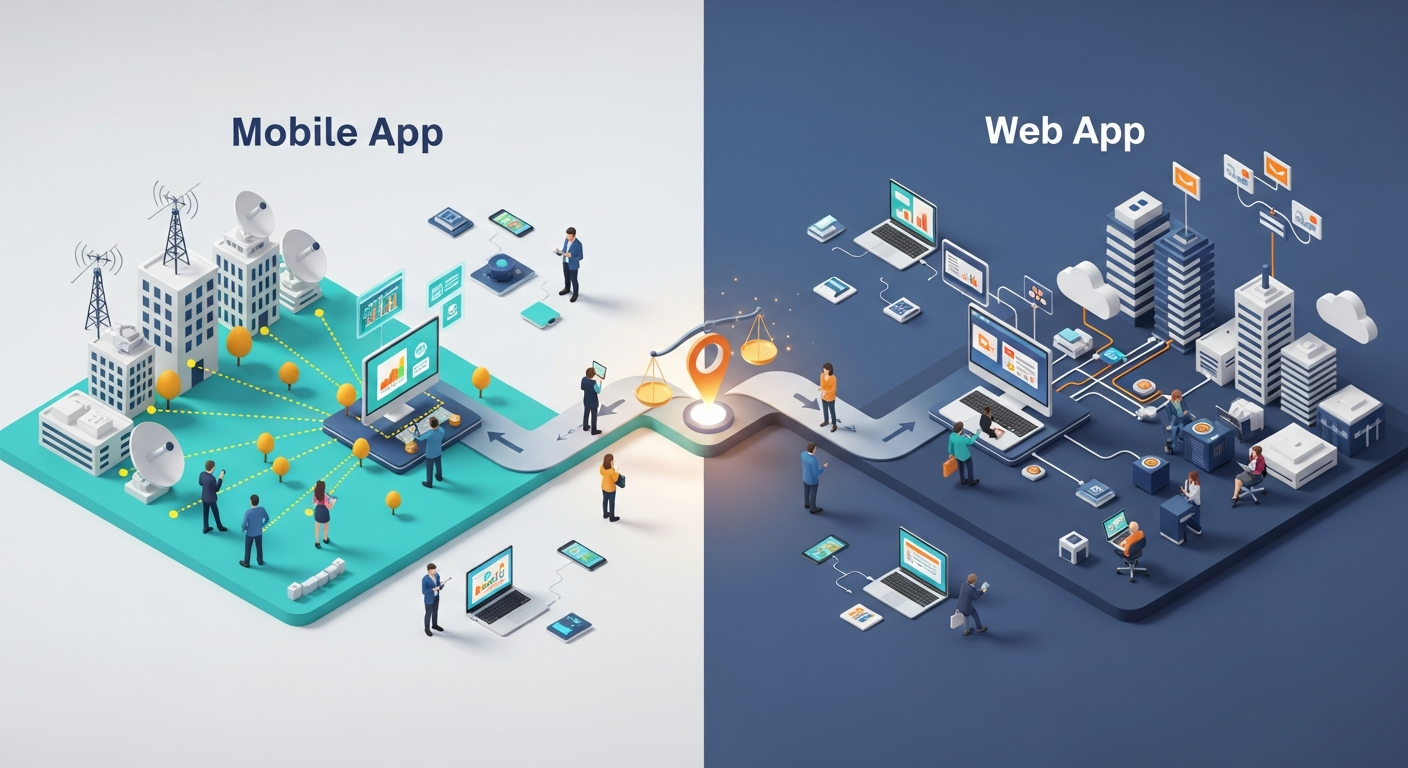
Mobile App vs Web App: Which Should Your Business Build First?
Should your business build a mobile app or a web app first? It is one of the most common questions business owners face when they are ready to go digital. And the answer is not always straightforward, because both options have real strengths depending on your situation.
A mobile app lives on your phone and is downloaded from an app store. A web app runs in a browser and works on any device with an internet connection. They can look similar on the surface, but the way they are built, distributed, and maintained is quite different.
In this article, we will compare mobile apps and web apps across the factors that matter most for your business, including cost, reach, performance, and user experience. By the end, you will have a clearer picture of which option makes the most sense as your first step. If you are exploring the mobile route, our guide on going from idea to app store covers the full journey.
Understanding the Key Differences
Before diving into which one is right for you, it helps to understand what sets them apart.
A web application is accessed through a browser like Chrome or Safari. Users do not need to download anything. They simply visit a URL and start using it. Web apps are built using standard web technologies and work across all devices and operating systems.
A mobile application is built specifically for iOS, Android, or both. It is downloaded from the Apple App Store or Google Play Store and installed directly on the user’s phone. Mobile apps can take advantage of phone-specific features like push notifications, camera access, GPS, and offline functionality.
There is also a middle ground called progressive web apps (PWAs), which are web apps that behave like mobile apps. They can work offline, send push notifications, and be added to a phone’s home screen, all without going through an app store.
When a Web App Is the Better Choice
Web apps are usually the better starting point for most businesses, especially if you are launching something new or working with a limited budget.
Lower Development Cost
Building a web app is generally less expensive than building a native mobile app. You build one version that works across all devices and browsers, instead of building separate versions for iOS and Android. This can save a significant amount of both time and money.
Easier to Update
When you update a web app, every user sees the changes immediately. There is no waiting for app store approvals or hoping that users download the latest version. This makes web apps easier to iterate on and faster to improve based on user feedback.
Wider Reach
Anyone with a browser can access a web app. There is no download barrier, which means lower friction for new users. This is especially important for businesses that rely on reaching as many people as possible. Pairing a well-built web app with strong responsive design and SEO practices means your application can attract users through search engines too.
When a Mobile App Makes More Sense
There are situations where a native mobile app is clearly the right choice.
You Need Device Features
If your product relies on camera access, GPS tracking, Bluetooth, biometric authentication, or other hardware features, a native mobile app gives you the best access and performance. Web apps can do some of this, but native apps do it better and more reliably.
Offline Functionality Is Critical
If your users need to work without an internet connection, a mobile app with offline support is the way to go. Think of field service workers, delivery drivers, or anyone working in areas with unreliable connectivity.
User Engagement Is Key
Mobile apps excel at keeping users engaged through push notifications, home screen presence, and smooth native performance. If your business model depends on daily or frequent user interaction, a mobile app can drive higher retention.
Cost and Timeline Comparison
Here is a practical comparison to help with planning:
- Web app: Typically 30 to 50 percent less expensive than native mobile apps. Development time is usually 2 to 4 months for a solid MVP.
- Single-platform mobile app (iOS or Android): Moderate cost, 3 to 5 months development time.
- Cross-platform mobile app (both iOS and Android): Higher cost, 4 to 6 months or more depending on complexity.
- PWA (progressive web app): Similar cost to a web app, with some mobile app benefits built in.
For more detailed cost expectations, our FAQ on custom software development costs in Oman gives you realistic pricing ranges.
The “Start Web, Go Mobile” Strategy
Many successful businesses start with a web app and add a mobile app later once they have validated their product and built a user base. This approach lets you launch faster, learn from real users, and invest in a mobile app when the demand is proven.
This strategy aligns well with the MVP approach that many startups use. Build the core product as a web app, test it, refine it, and then expand to mobile when the time is right.
If you are still deciding between the two, talking to an experienced app development team can help you map out the right path. The best choice is the one that matches your users’ needs, your budget, and your timeline.
At Masirat, we help businesses in Oman figure out the right platform strategy before writing a single line of code. As a software development company in Oman, we build both web and mobile applications, and we are always honest about which one makes more sense for your specific situation. Need to get found online too? Our SEO team can help with that. Running a pharmacy? Pharmasolo is built to handle your operations from day one.


