
Pharmacy Software Compliance in UAE: DHA, MOHAP, and NABIDH Explained
Compliance is the least exciting part of running a pharmacy in the UAE. It is also the part that puts more pharmacies into trouble than any other operational issue. Inspectors do not care whether your shelves look polished or your customer service is friendly. They care whether your software talks to NABIDH, whether your VAT records reconcile cleanly, whether your controlled drug logs match dispensing reality, and whether the medicines on your shelf can be traced through Tatmeen.
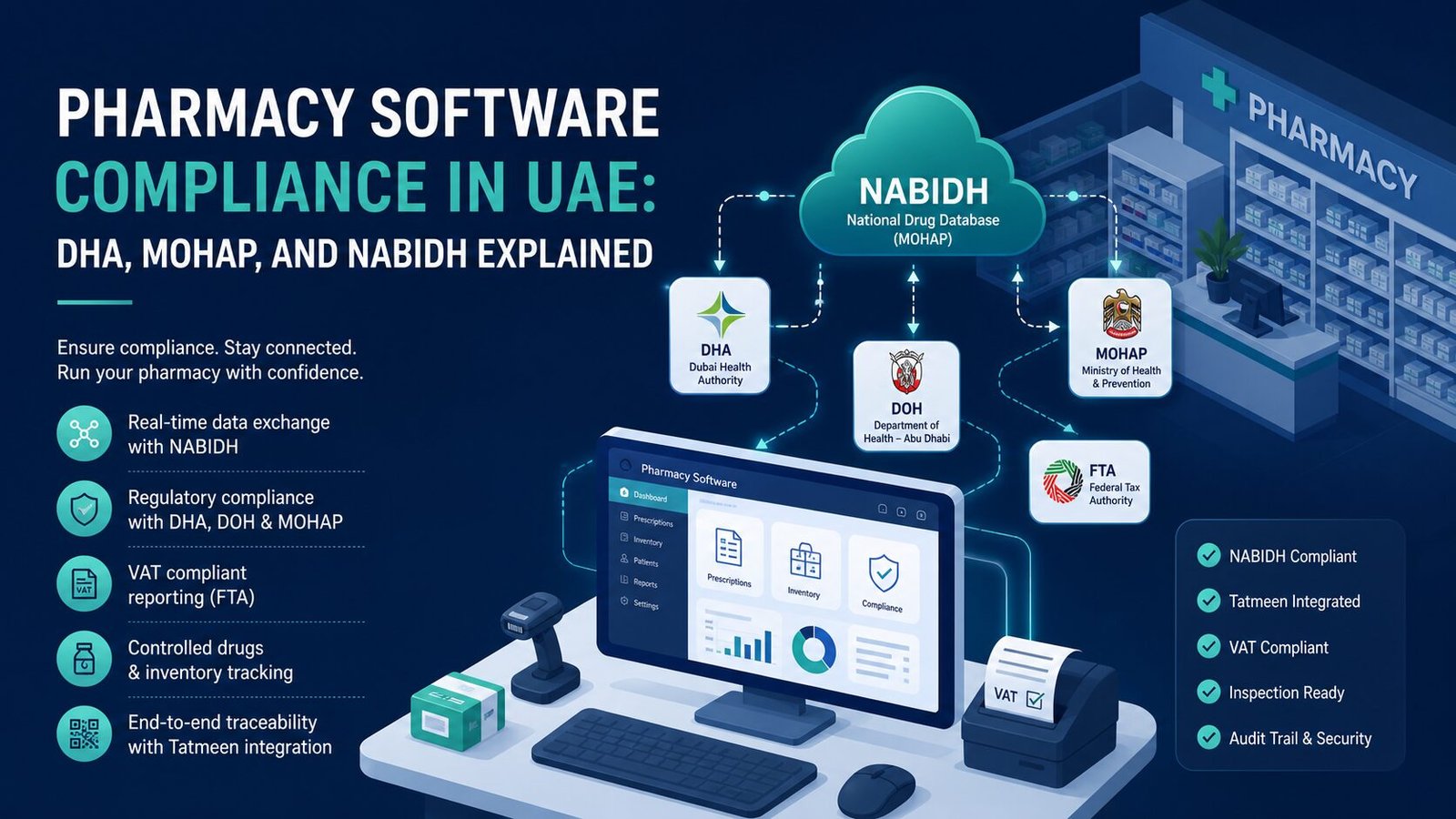
This guide breaks down what UAE pharmacy software actually needs to handle so compliance is not something you fight every quarter. We’ve built it around the authorities that touch a typical pharmacy: DHA in Dubai, DOH in Abu Dhabi, MOHAP federally and across the Northern Emirates, and the FTA for VAT.
Why Compliance Carries More Weight in the UAE Than Most Markets
Three reasons compliance is taken more seriously here than in many other markets.
The first is regulatory maturity. The UAE has built one of the most digitally connected healthcare systems in the region. Health information exchanges (NABIDH, Malaffi, Riayati) are now interconnected, drug traceability through Tatmeen runs across every emirate, and federal law sets a single baseline that every pharmacy must meet. There is no room to ignore a system because it is “still in pilot.”
The second is enforcement. Inspections happen. Licences get suspended. Pharmacies that misreport controlled substances or fail to integrate with mandatory health platforms can lose the right to operate. We’ve seen owners assume non-compliance is a fineable offence and discover too late that it can be operational shutdown.
The third is insurance economics. Most UAE pharmacies generate the majority of revenue through insurance claims. If your software does not comply with the data standards required by Daman, Thiqa, NextCare, and the rest, your claims get rejected and your cash flow suffers. Compliance and revenue are tied together more tightly here than in markets where retail walk-in dominates.
The Authorities Your Pharmacy Software Must Answer To
UAE pharmacy compliance touches several bodies. Your software needs to satisfy each one that applies to your operating emirate.
Dubai Health Authority (DHA)
DHA regulates pharmacies in Dubai and operates the NABIDH health information exchange. For pharmacy software, DHA compliance means real-time integration with NABIDH for dispensing and prescription data, support for DHA-issued e-prescriptions, alignment with DHA controlled drug reporting requirements, and integration with the DHA Sheryan portal for pharmacist licensing records.
Department of Health Abu Dhabi (DOH)
DOH regulates Abu Dhabi pharmacies and runs Malaffi, the emirate’s HIE. Malaffi connects more than 2,700 facilities in Abu Dhabi and exchanges data with both NABIDH and Riayati. Pharmacy software operating in Abu Dhabi must integrate with Malaffi for prescription and dispensing flow, follow DOH’s specific reporting cadence, and meet DOH controlled drug rules.
Ministry of Health and Prevention (MOHAP)
MOHAP is the federal authority responsible for the Northern Emirates pharmacy regulation (Sharjah, Ajman, Fujairah, Ras Al Khaimah, Umm Al Quwain) and runs Riayati, the National Unified Medical Record. Riayati now holds 1.9 billion medical records for 9.5 million patients across more than 3,000 facilities. Software running in MOHAP-regulated pharmacies must integrate with Riayati and meet federal pharmaceutical regulations under Federal Law No. 8 of 2019 and Executive Regulation No. 6 of 2023.
Federal Tax Authority (FTA)
VAT compliance is universal across the UAE. Every pharmacy charges 5% VAT on standard-rated products, files quarterly returns, and must keep audit-ready records for at least five years. Pharmacy software must produce FTA-compliant tax invoices, separate standard-rated from zero-rated items, and generate the data needed for quarterly VAT returns.
What NABIDH Compliance Actually Means for Pharmacy Software
NABIDH (the National Unified Medical Record for Dubai) is the most often discussed compliance requirement, and the one that confuses new pharmacy owners most.
In practical terms, NABIDH compliance means your pharmacy software must:
- Send dispensing data securely to NABIDH using HL7 FHIR or DHA-approved standards
- Pull patient health records and prescriptions from NABIDH when needed
- Record dispensing events with the correct patient ID, prescriber details, and medication codes
- Handle e-prescriptions issued through DHA-licensed clinicians
- Meet NABIDH’s data security standards. DHA added AI-based monitoring of NABIDH data security in April 2025, which raised the bar for vendors.
Software that was not built for NABIDH from the ground up tends to bolt on integration as an external layer, which fails inspections more often than vendors admit. The right software handles NABIDH as a native part of the dispensing workflow, not an afterthought. We cover the deeper detail of how NABIDH and Riayati e-prescriptions actually move through pharmacy systems in our guide on e-prescription in the UAE.
For the official position on NABIDH, DHA maintains documentation at the NABIDH portal.
Malaffi and Riayati: How They Fit Together
NABIDH covers Dubai. Pharmacies elsewhere answer to different platforms. Malaffi is Abu Dhabi’s HIE, run by the Department of Health, and was the region’s first such platform when it launched in 2019. Riayati is the federal MOHAP platform that connects the Northern Emirates and serves as the National Unified Medical Record across the country.
All three platforms are now integrated. A patient’s health record can flow across NABIDH, Malaffi, and Riayati through the federal Riayati layer. This integration was completed in stages, with the formal agreement signed at Arab Health 2023.
For your pharmacy software, this means you need integration with the platform that covers your operating emirate, plus support for the federal data exchange standards if your patients have records across multiple emirates. Pharmacies operating across emirates need software that connects to multiple HIEs without manual workarounds. Single-emirate vendors often cannot scale with you when you open a second branch in a different emirate.
Tatmeen: UAE Drug Traceability
Tatmeen is the UAE’s drug traceability system. It tracks every pharmaceutical product from manufacturer to patient using unique identifiers on each pack. Pharmacies must scan and register every dispensing event in Tatmeen. The goal is to eliminate counterfeit medicines and strengthen recall capability across the supply chain.
Software requirements for Tatmeen include barcode scanning at receiving and dispensing, automatic Tatmeen API submission, batch and expiry tracking integrated with Tatmeen’s records, and reconciliation tools that catch mismatches before they become inspection failures. Software that handles Tatmeen well also reduces inventory shrinkage and counterfeit risk inside your own pharmacy.
Other Compliance Areas Your Software Must Handle
A few areas come up less often in vendor pitches but matter every month of operation.
Insurance Network Compliance
Daman, Thiqa, NextCare, MSH International, ADNIC, Mednet, and others operate on specific data formats and submission standards. Your software must support each network’s claim submission requirements, pre-authorisation workflows, rejection handling, and resubmission cycles. The networks you sign up with depend on your pharmacy’s location, target customers, and partnerships, but most pharmacies need at least three or four. We cover this side of operations in detail in our guide to UAE pharmacy insurance claims.
Controlled and Narcotic Substances
Federal Law No. 8 of 2019 and Executive Regulation No. 6 of 2023 set strict rules for controlled drug handling. Pharmacy software must maintain controlled drug registers, track dispensing against valid prescriptions, generate compliance reports for DHA, DOH, or MOHAP audits, and prevent unauthorised dispensing through access controls. Manual controlled drug ledgers are a fast route to compliance gaps.
VAT and FTA Reporting
5% VAT applies to most pharmacy products. Your software must produce VAT-compliant tax invoices, correctly classify standard-rated, zero-rated, and exempt items (certain pharmaceuticals and medical equipment may qualify for zero-rating under FTA Public Clarifications), generate quarterly VAT returns in the format FTA requires, and keep records for at least five years.
Data Security and Residency
UAE healthcare data protection rules require patient data to be stored securely, with specific provisions on data residency. Cloud software providers must clarify where data physically resides. Encryption at rest and in transit, role-based access controls, audit logs, and breach notification protocols are all expected. NABIDH’s April 2025 AI-based monitoring update means vendors are now actively watched for security posture, not just self-certified.
How to Verify a Pharmacy Software Vendor’s Compliance Claims
Vendors claim NABIDH, Malaffi, or Riayati certification all the time. Some have it. Some have it for parts of their platform but not the modules you need. Some are working on it.
Before you sign a contract, ask the vendor to:
- Provide their NABIDH (or Malaffi, or Riayati) integration certification document issued directly by the relevant authority
- Demonstrate a live dispensing event that pushes data to the HIE in real time
- Name the UAE pharmacies running their software in production today
- Connect you with one of those pharmacy owners for a reference call
- Explain how compliance updates are handled when DHA, MOHAP, or DOH change data standards
- Clarify whether compliance updates carry extra cost or are part of the licence
- Show how multi-emirate pharmacies are handled in a single account
Vendors who can answer all of these clearly and verifiably are worth shortlisting. Vendors who deflect or promise that integration is “coming soon” rarely deliver in the timeframe a new pharmacy needs.
How Pharmasolo Approaches UAE Compliance
Pharmasolo is built for the UAE pharmacy compliance landscape natively. NABIDH integration is part of the dispensing workflow rather than a separate module bolted on top. The platform supports DHA, MOHAP, and DOH dispensing standards, handles Tatmeen scanning and reporting, manages every major UAE insurance network, and produces FTA-compliant VAT records out of the box. Multi-emirate operation is supported in a single account.
If you are evaluating pharmacy software for a new Dubai or UAE pharmacy, explore Pharmasolo’s Dubai pharmacy software platform or read our Pharmasolo UAE launch announcement for the full feature breakdown. The most recent compliance enhancements are detailed in our DHA, MOHAP, and NABIDH support update.
For pharmacy owners scaling from Oman or other GCC markets into the UAE, our Pharmasolo platform overview explains the regional architecture.
Frequently Asked Questions
Is NABIDH integration mandatory for pharmacies in Dubai? Yes. All pharmacies operating in Dubai must integrate their dispensing systems with NABIDH to share and access patient health records.
Do pharmacies in the Northern Emirates need to integrate with Riayati? Yes. Pharmacies in Sharjah, Ajman, Fujairah, Ras Al Khaimah, and Umm Al Quwain operate under MOHAP regulation and must integrate with Riayati, the National Unified Medical Record.
What happens if my pharmacy software is not NABIDH compliant? Your pharmacy can fail DHA inspections, face penalties, and ultimately lose the right to operate in Dubai. Insurance claims may also be rejected if dispensing data does not flow correctly.
Are NABIDH, Malaffi, and Riayati the same system? No. NABIDH is Dubai’s HIE, Malaffi is Abu Dhabi’s, and Riayati is the federal/Northern Emirates platform. They are integrated but operated by different authorities.
Does Pharmasolo support all three HIEs? Yes. Pharmasolo supports NABIDH (Dubai), Malaffi (Abu Dhabi), and Riayati (Northern Emirates and federal layer) for pharmacies operating in any UAE emirate.
What is Tatmeen and why does my software need to support it? Tatmeen is the UAE’s mandatory drug traceability system. Every pharmacy must scan and register dispensing events through Tatmeen to track medicines from manufacturer to patient. Without Tatmeen integration, you cannot legally dispense most pharmaceutical products.
How often do compliance standards change? DHA, MOHAP, and DOH issue updates regularly. Major changes (like the April 2025 NABIDH AI security update) require pharmacy software vendors to push updates promptly. Choose a vendor that handles compliance updates as part of the licence.
Get Compliance Right From Day One
Compliance is not a project. It is an ongoing operational requirement that touches your pharmacy every time you dispense, claim, or report. The right software makes it invisible. The wrong one makes it your weekly headache.
If you want to evaluate a platform built for UAE compliance from the ground up, request a Pharmasolo demo for your UAE pharmacy. We’ll walk you through NABIDH, Malaffi, Riayati, Tatmeen, and FTA support, and show you how each piece fits into a single dispensing workflow.


5 Comments
How to Open a Pharmacy in Dubai: A 2026 Step-by-Step Guide - Masirat Technology
May 5, 2026[…] right pharmacy software setup prevents the third and fourth mistakes on that list, and getting your compliance posture right from day one prevents the […]
10 Must-Have Features in Pharmacy Software for UAE Pharmacies - Masirat Technology
May 5, 2026[…] context on why each compliance feature matters and how UAE authorities actually enforce them, our pharmacy software compliance guide walks through the regulatory landscape in […]
UAE Pharmacy Insurance Claims: Daman, Thiqa, NextCare
May 5, 2026[…] We cover the broader feature evaluation in our guide to the 10 must-have features for UAE pharmacy software, and the regulatory context behind claim formats in our pharmacy software compliance guide. […]
Multi-Branch Pharmacy Management in the UAE: A Guide for Growing Chains - Masirat Technology
June 4, 2026[…] We cover the broader feature evaluation in our guide to the 10 must-have features for UAE pharmacy software, and the compliance landscape in our pharmacy software compliance guide. […]
Pharmasolo Launches in UAE: Pharmacy Software for Dubai
June 9, 2026[…] Full compliance integration. Native integration with NABIDH for Dubai pharmacies, Malaffi for Abu Dhabi, and Riayati for the Northern Emirates and federal layer. Tatmeen drug traceability is part of the dispensing workflow, not a separate module. The platform supports DHA, DOH, and MOHAP dispensing and reporting standards. We explain the full compliance picture in our pharmacy software compliance guide. […]