


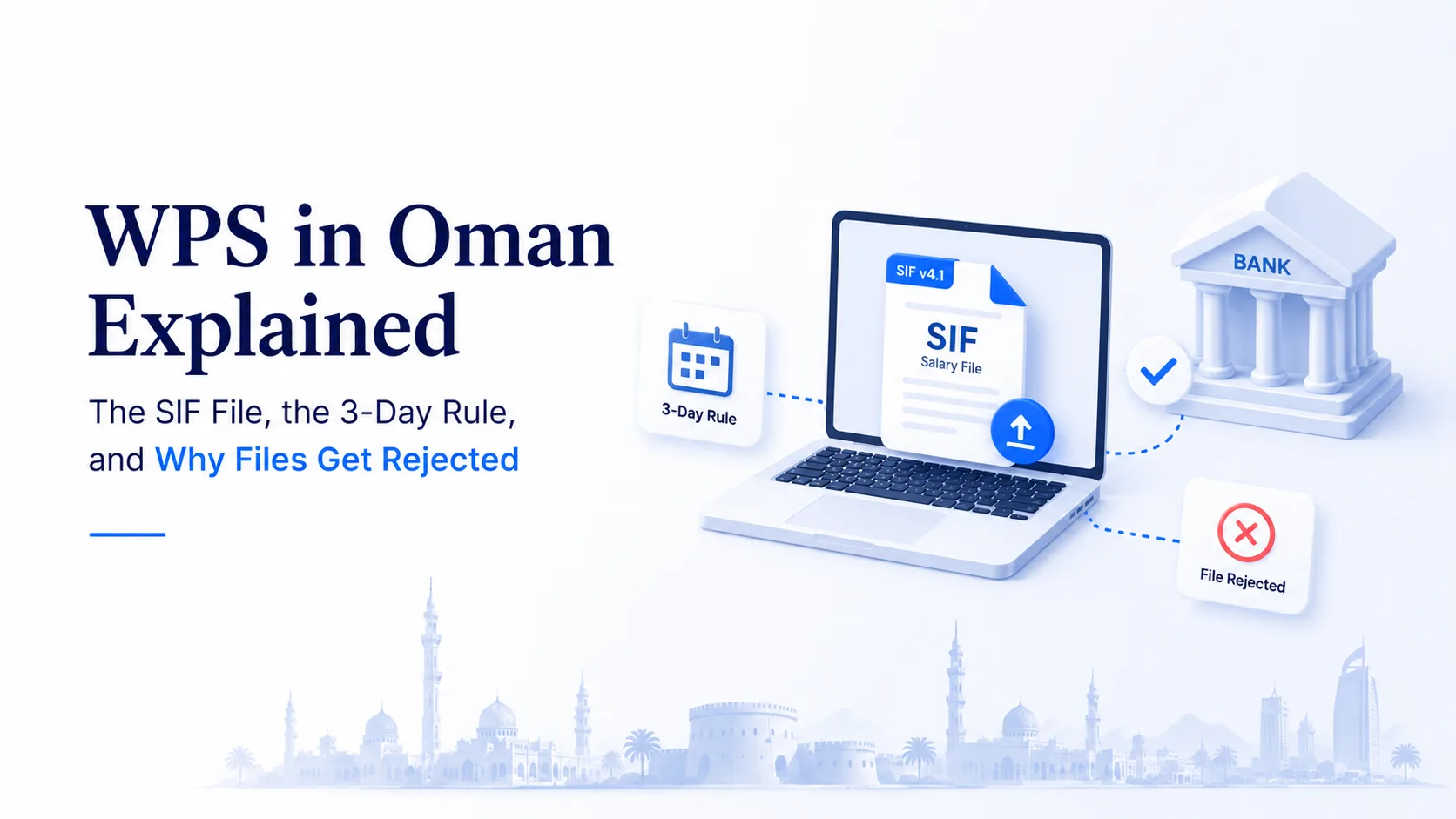
WPS in Oman Explained: The SIF File, the 3-Day Rule, and Why Files Get Rejected
Every month, payroll teams across Oman do the same nervous dance. They build the salary file, upload it to the bank, and wait to see if it goes through. Sometimes it does. Sometimes the bank bounces it back with an error nobody can quite explain, and the clock is already ticking.
If that sounds familiar, this guide is for you. Here is how the Wage Protection System actually works in Oman, what changed in the latest update, and why files get rejected.
What the WPS Is
The Wage Protection System, or WPS, is how Oman makes sure private sector salaries reach employees on time and through proper banking channels.
It is run by the Ministry of Labour, with the file format set by the Central Bank of Oman. Every licensed bank enforces both. Instead of paying staff in cash or through informal transfers, employers upload a monthly payroll file to their bank, and the salaries move from there.
For private sector employers in Oman, WPS is not optional. Salaries have to move through a licensed Omani bank in the approved format. Cash payments and ad-hoc transfers outside the WPS channel do not count as compliant.
The point of all this is protection and proof. Before WPS, wage disputes were one person’s word against another’s. Now every salary has a record, every file has a timestamp at the bank, and the Ministry has a clean trail if a complaint comes in.
The Rule That Changed in 2024
This is the part most guides still get wrong, so read it carefully.
For a while, WPS in Oman ran under Ministerial Decision No. 299 of 2023. That decision has been revoked. The current rule is Ministerial Decision No. 729 of 2024, which came into force on 16 December 2024 and aligns the WPS with the Labour Law under Royal Decree 53/2023.
The most important change is the deadline. Under the current rule, employers must transfer wages through the WPS within no more than three days from the end of the wage entitlement period. The older seven-day window no longer applies.
A few other points from the current decision worth knowing:
- Salaries must go to a bank or financial institution regulated by the Central Bank of Oman.
- Wage payments must match the terms in the employee’s contract. If a salary changes, the contract has to be updated to reflect it.
- The Ministry of Labour has a dedicated division watching compliance, with more scrutiny than before.
If you have read older articles quoting a seven-day rule, they are out of date. Compliance content ages fast, which is exactly why it pays to check the current decision rather than trust last year’s blog post.
What Goes Inside a SIF File
The file you upload each month is called a Salary Information File, or SIF. It is a structured file containing the payroll data for every employee for that month.
In plain terms, it tells the bank and the Ministry who is getting paid, how much, into which account, and for what period. The exact format and field layout are set by the Central Bank of Oman, and your bank expects the file to match that specification precisely.
That precision is where most of the monthly pain comes from.
Why WPS Files Get Rejected
A rejected file is almost never random. It is the system catching a mismatch. Here are the common reasons a SIF file bounces back.
Employee bank details do not match. The account number, name, or bank code in your file does not match what is registered. This is the single most common cause.
An employee is not registered in the WPS database. A new hire was added to payroll but never registered for WPS, so the system has no record to match against.
The company details are wrong. The commercial registration number or the company account linked to the file does not line up with what the bank has on record.
The format or layout is off. A wrong column, a missing field, a date in the wrong format, or an outdated file version. The specification is strict and small errors break the whole file.
The totals do not add up. The sum of individual salaries in the file does not match the total transfer amount, so the bank refuses it.
Duplicate or missing records. The same employee appears twice, or someone who should be paid is missing entirely.
The frustrating part is that one bad row can reject the entire file. So a single mistyped account number for one employee can hold up payroll for everyone, with the three-day clock still running.
What Happens If You Miss the Deadline
Missing the WPS deadline is not a quiet problem. Under the current decision, penalties include warnings, suspension of work permit services, and fines of OMR 50 per worker, which double for repeat offences.
Suspended work permit services are often the bigger sting than the fine. It can hold up visa renewals and new hires across the whole company, which turns a payroll slip into an operations problem.
How to Stop Fighting WPS Every Month
Most of the rejection reasons above come from one root cause: payroll data living in spreadsheets, where it drifts out of sync with what the bank and the Ministry expect.
This is where proper HR and payroll software earns its place. A system that holds clean, validated employee records, generates the SIF in the correct format, and checks the file before you upload it removes most of the monthly guesswork. NoorHR was built to do exactly this for organizations in Oman. It generates WPS files in the format the banks accept, pre-validates them before download to cut down on rejections, and tracks the deadline so payroll does not slip past the three-day window. You can see how it handles Oman compliance on the NoorHR page for organizations in Oman.
The WPS is not going away, and the rules will keep tightening. The teams that stop dreading it are the ones who stop running payroll out of a spreadsheet.
One note before you act on any of this: WPS rules and penalties are updated periodically by the Ministry of Labour and the Central Bank of Oman. Always confirm the current requirements against the official sources or your bank before making compliance decisions.
Work with Masirat Technology
We build software and run digital marketing for organizations across Oman, from our base in Muttrah, Muscat. Alongside NoorHR for HR and payroll, we build Pharmasolo for pharmacies and Manage Desk for accounting, plus custom software, websites, and apps for businesses that want a local team they can actually reach. Take a look at our products and our recent work, or talk to our team about what you need.


