


Passport and Visa Expiry Tracking: Avoiding Fines for Oman Employers
Most compliance fines in Oman are not caused by bad intent. They are caused by a date nobody was watching. A residence card expired three weeks ago, the employee did not flag it, HR was busy with payroll, and now there is a fine and a scramble.
For any company in Oman with expat staff, document expiry is a quiet, constant risk. Here is what you have to track, what happens when you miss a date, and how to stop relying on memory and spreadsheets.
The Three Documents You Have to Track
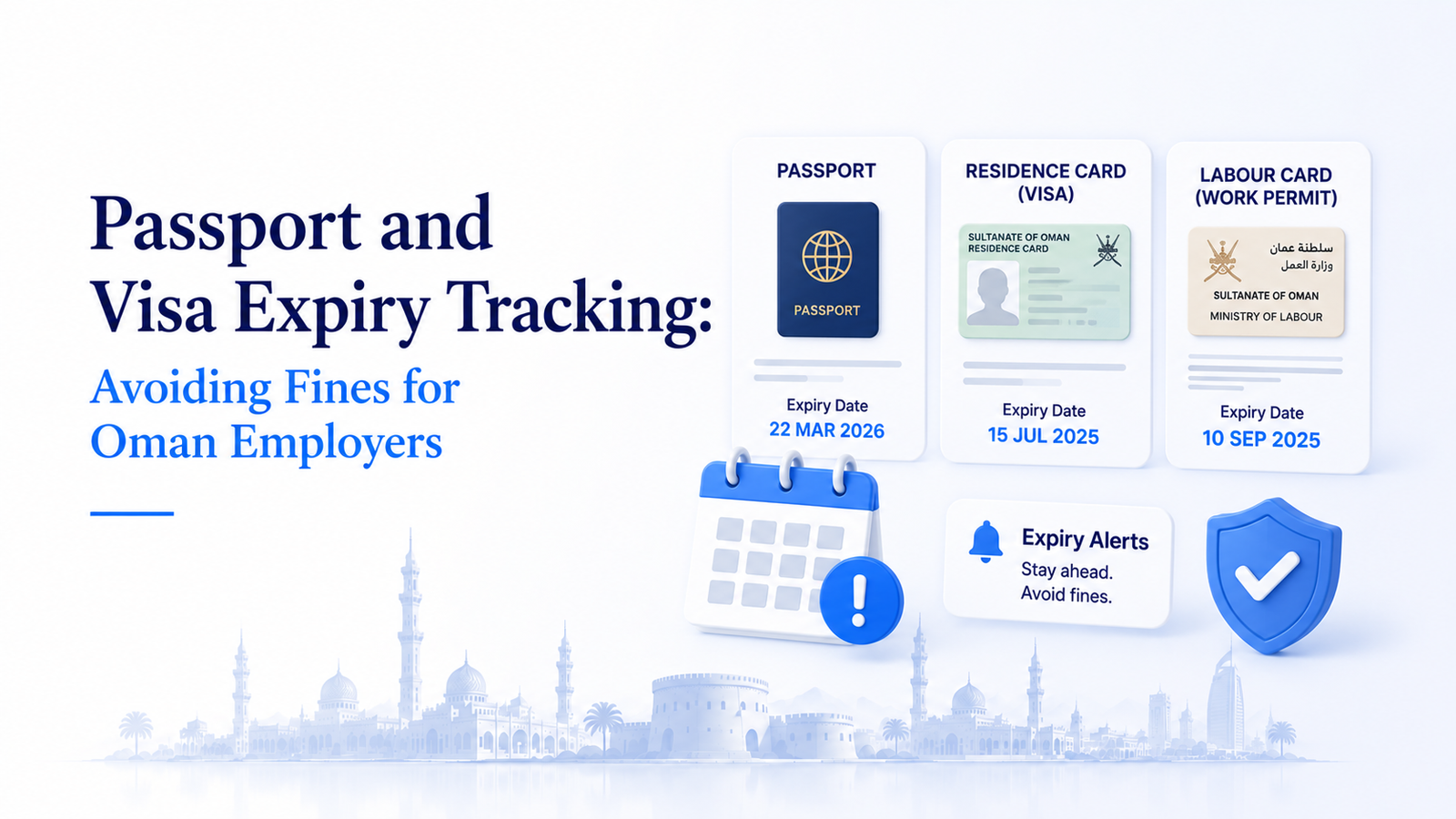
For every expatriate employee, there are three documents with expiry dates that matter.
The passport. If an employee’s passport is close to expiry, most other renewals stall, because the residence card cannot extend beyond the passport. So passport expiry quietly drives everything else.
The residence card, often called the visa. This is issued by the Royal Oman Police, and every expatriate resident must hold a valid one. It has a fixed validity and must be renewed before it lapses.
The labour card or work permit. This sits with the Ministry of Labour and ties the employee’s legal right to work to their employer.
Three documents, three different authorities, three different expiry dates, multiplied by every expat on your payroll. That is the scale of the tracking problem.
Why It Is the Employer’s Problem, Not the Employee’s
It is easy to assume the employee will keep an eye on their own documents. In practice, the sponsoring employer carries the responsibility and usually the cost when something lapses.
The company is the sponsor. The company processes the renewals. And when a fine lands or a renewal is blocked, it is the company that deals with it, not just the individual. So treating expiry tracking as the employee’s job is a risk you end up paying for.
What Happens When a Document Expires
Letting a document lapse is not a minor admin slip. The consequences stack up.
Fines accrue over time, often on a daily basis for an overstayed residence permit, and there is frequently no grace period. Beyond the money, an expired document can block other transactions, hold up exit or travel, prevent the employee from completing official processes, and in serious or prolonged cases lead to legal action or deportation.
There is an operational cost too. One expired card can freeze a renewal that you needed done before a new project, a travel date, or a hire. A payroll-day problem becomes a business problem.
It is worth noting that Oman has, at times, run amnesty or fine-waiver periods to let people regularise their status. Those are temporary and conditional, not something to plan around. The safe assumption is simple: renew before the date, every time.
Renew Before It Expires, Not After
A key point that catches people out is timing. The rules require you to act before a document expires, not after. Renewal requests are meant to be submitted ahead of the expiry date, not in the days after it lapses.
That means your tracking cannot just tell you when something has expired. It has to warn you well before, so there is time to gather documents, complete any medical checks, and submit the renewal on time. Because the exact renewal windows and fees are set by the Royal Oman Police and can change, always confirm the current requirement on the official ROP channels before you act.
Why Spreadsheets Fail at This
A spreadsheet of expiry dates has one fatal flaw. It does not tell you anything. It just sits there. Someone has to remember to open it, scan every row, and act before each date. Across dozens of employees with different documents and different dates, something will eventually slip.
The common failures:
- Nobody opened the sheet in time.
- A new hire was added to payroll but their dates were never entered.
- The sheet was updated, but no reminder was set.
- The one person who watched the dates went on leave.
None of these are laziness. They are what happens when a critical task depends on a human remembering to check a static file.
How Automated Expiry Tracking Works
This is the simplest, clearest case for proper HR software. The system holds every employee’s passport, residence card, and work permit dates, and it pushes alerts well before each expiry, so the renewal starts on time instead of after a fine.
NoorHR tracks passport, visa, and work permit expiry for every employee and sends automated alerts ahead of each date, with a live view of what is coming up due across the whole company, including across multiple branches and companies in a group. Nothing depends on someone remembering to open a sheet. You can see how it handles this alongside the rest of Oman compliance on the NoorHR page for organizations in Oman.
The point is to move from finding out after the fact to being warned in advance. That single shift is the difference between a renewal and a fine.
One note before you act on any of this. Residence, visa, and labour rules in Oman are set by the Royal Oman Police and the Ministry of Labour, and validity periods, renewal windows, and fines change from time to time. Always confirm the current rules through the official ROP and Ministry of Labour channels or a qualified advisor.
Work with Masirat Technology
We build software and run digital marketing for organizations across Oman, from our base in Muttrah, Muscat. Alongside NoorHR for HR and payroll, we build Pharmasolo for pharmacies and Manage Desk for accounting, plus custom software, websites, and apps for businesses that want a local team they can actually reach. Take a look at our products and our recent work, or talk to our team about what you need.


